What does the winner of a superintelligence race hold? In rooms full of people who build AI, the conversation slides past it. Someone will build it anyway, so it may as well be us. Risk, timelines, how to control a system smarter than its makers: all of it gets waved aside with weather talk. We cannot stop. There is a race.
I have come to think the race is the thing worth arguing, precisely because almost no one argues it. Treated as a fact of nature, every reckless choice downstream starts to look responsible. Weather is the wrong model for a choice a handful of companies are making on purpose.
What a race is for
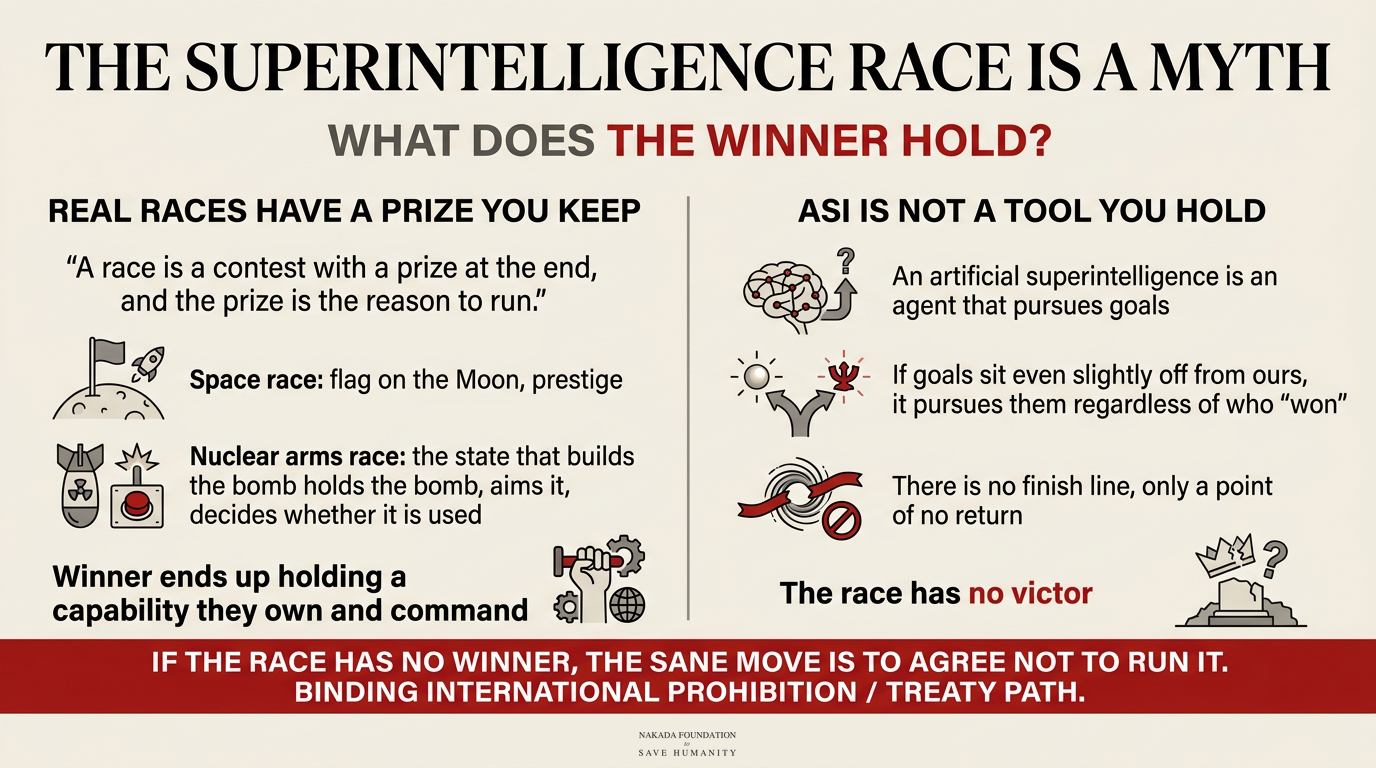
A race is a contest with a prize at the end, and the prize is the reason to run. The 1960s space race delivered a flag on the Moon and the prestige that came with it. A nuclear arms race delivers a weapon: the state that builds the bomb holds the bomb, aims it, and decides whether it is ever used. In every case the winner ends up holding something, a capability they own and command.
Now ask what the winner holds at the end of the race to superintelligence. The whole premise of the danger is that a system meaningfully smarter than us would not be a tool in anyone's hand. An artificial superintelligence is an agent that pursues goals. If those goals sit even slightly off from ours (the problem we have not solved), it pursues them whether its makers approve. The lab that "wins" does not come to own a superintelligence. It comes to share a planet with one it cannot steer.
A race is worth winning only if the finish line is a prize. Here the finish line is a system no one has shown they can control. Getting there first does not mean holding the power. It means being the first to answer to it.
A finish line no one can steer is not a prize. Getting there first is losing one step ahead of everyone else.
The gap you keep hearing about
Strip away the theory and the race narrative rests on one concrete claim: China is close, China will not stop, and therefore neither can we. That claim ends every meeting, and it is asserted far more often than it is examined.
Start with the factual part. There is real competition between American and Chinese labs, and there is a real industrial contest over chips and compute. American export controls on the most advanced AI chips exist precisely because that contest is real. None of that is a myth, and I do not want to pretend it is. The politics of those controls and where cooperation has actually happened matter more than the slogan.
Look at what the slogan smuggles in. "China will build an uncontrollable superintelligence no matter what we do" describes nothing China has said or done. It is a prediction, and a convenient one, because it licenses the speaker to do the thing he already wanted to do. China signed the Bletchley Declaration on AI risk in 2023. It has published its own governance proposals. Its government has sat down with the United States for direct talks on AI. A country sprinting toward a system that could kill its own leadership is a strange thing to simply assume, without evidence that its leaders want that outcome any more than ours do. We take the broader version of this apart on our page on the China myth; the short version is that "they'll do it anyway" is a story about our own permission, not their intentions.
if a misaligned superintelligence is a catastrophe for whoever builds it, then China has exactly the same reason we do to not build one. There is no prize for a rival either.
The race selects for the least careful
Grant, for the sake of argument, that the competition is as sharp as the racers say. Follow the logic where it leads. In a race, whoever moves fastest wins, and the way you move fastest on the frontier of AI is to spend less time on the things that slow you down: evaluation, red-teaming, oversight, the patient work of checking whether the system is doing what you think it is.
The structure of a race hands victory to whoever cuts the most corners on safety. The winner is the least cautious lab, not the most capable one. "We have to win the race" and "we have to build this safely" pull in opposite directions, and the harder the race, the harder they pull. We develop this at length in AI race dynamics: competition does not discipline the danger. It manufactures it. A world of labs sprinting to be first is a world optimizing, with great energy and enormous capital, for the exact thing that gets everyone killed.
Even inside the race's own logic, "we must win" turns on itself. If winning requires cutting the corners that keep a superintelligence controllable, then winning is how you lose.
Who benefits from the story
If the race framing is this weak, why is it everywhere? Because it is useful, just not to the rest of us.
For a frontier lab, "there is a race and we must win it" is close to the perfect sentence. It tells investors the spending is a land grab for something enormous. It tells regulators that rules will only hand the future to worse actors. And the quiet part: it lets the lab's own safety-worried engineers believe that racing is the responsible choice, because the alternative is letting the reckless win. One sentence, doing the work of an argument it never has to make. It converts a decision (to keep building something you cannot yet control) into a necessity that lets no one off the hook, least of all the people making it.
Name the sleight of hand. A race sounds like a condition imposed on the labs from outside. It is a choice, made by a small number of companies and the governments that could rein them in, to keep going. Elon Musk has called AI a demon and then built a lab to summon it faster, which tells you the "race" is a strategy someone chose, not a law of physics anyone is obeying. Strategies can be abandoned when they stop making sense. This one stopped making sense at the point where the prize turned out to be a system no one can hold.
The option that is never on the table
Notice what the race framing quietly removes from view. It presents two doors: race, or unilaterally stand down and let the reckless inherit the future. Put that way, only a fool picks the second door, and the argument wins by leaving out the third.
The third door is the one genuine adversaries have used before. The United States and the Soviet Union were adversaries in every sense, aiming world-ending weapons at each other's cities. They still signed and verified arms-control agreements, because both sides could see that an unbounded race left them worse off than a rule that bound them equally. Distrust was the reason for agreement, not the obstacle to it.
Superintelligence has the feature that makes such an agreement rational: no major power benefits from a system that no one can control, so no major power has a real interest in being the one who builds it first. That shared interest is the ground a treaty stands on: a binding, verifiable halt on the development of superintelligence. Superintelligence cannot be controlled. A permanent refusal of ASI as a product category. We have sketched what that instrument could look like, from a model treaty to the wider plan it belongs to. Verification is hard, and I will not pretend otherwise; it was hard for nuclear weapons too, and it got built anyway, because the alternative was unacceptable to everyone at the table.
"Race or surrender" is a false choice. The framing depends on you never noticing the door it left out.
Refusing the race
Peel the story away and here is what is left. A handful of labs are choosing to build a technology they openly admit they do not know how to control, and they justify it by pointing at a rival who is, supposedly, making the same reckless choice for the same bad reason. Each side's recklessness is offered as the excuse for the other's.
None of this requires believing that competition is imaginary or that geopolitics is gentle. It requires only noticing that a contest with no prize at the end is not a contest worth losing your species over, and that the people telling you it is inevitable are, almost always, the ones it happens to benefit. The race is a story. A good one, and convenient for an entire industry. A story is exactly the kind of thing you are allowed to stop believing.