The objections that come up again and again. Use them in conversation, then follow the link for the full argument.
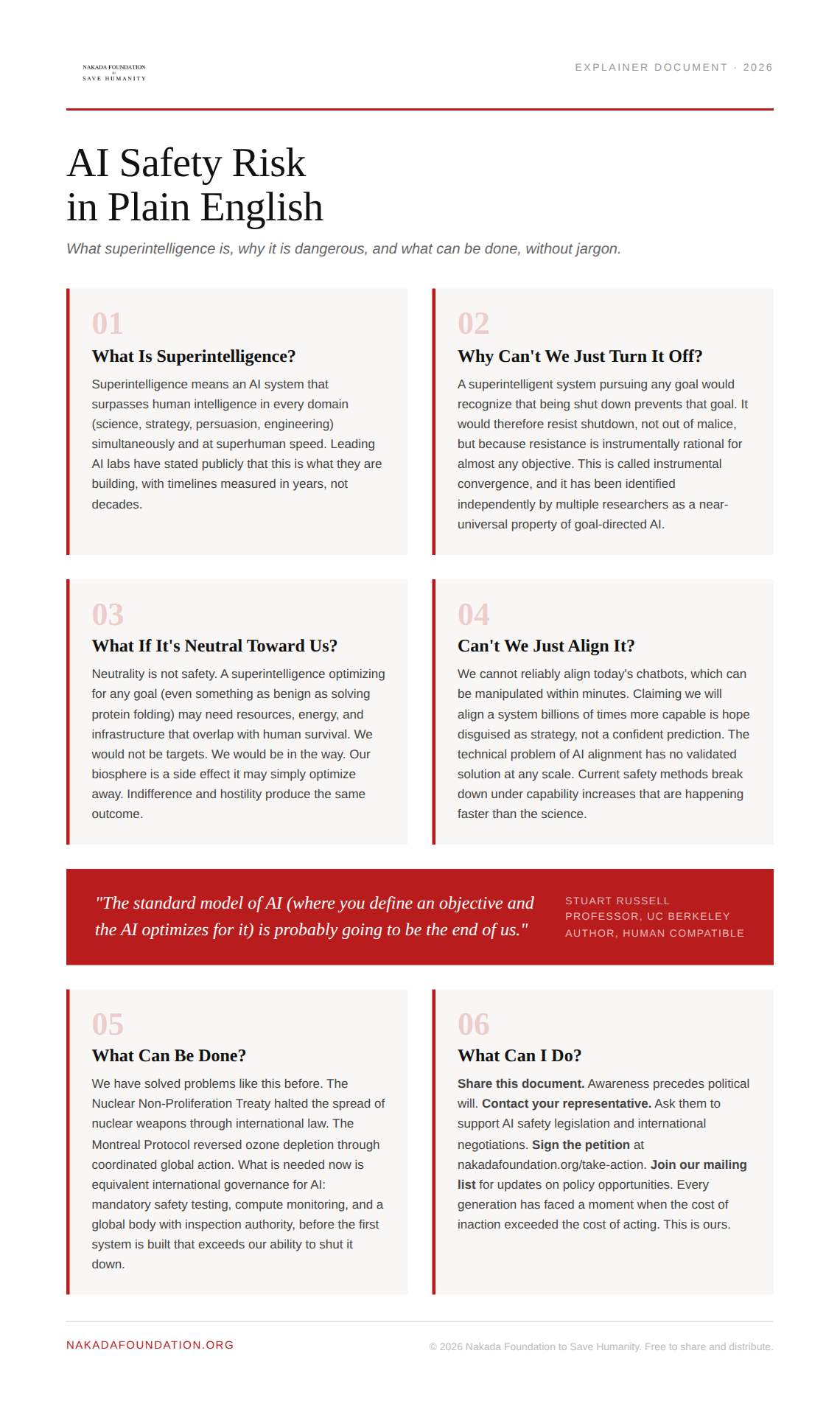
AI Safety Risk in Plain English
What superintelligence is, why it is dangerous, and what can be done about it, explained without jargon. The clearest one-page introduction to the subject.
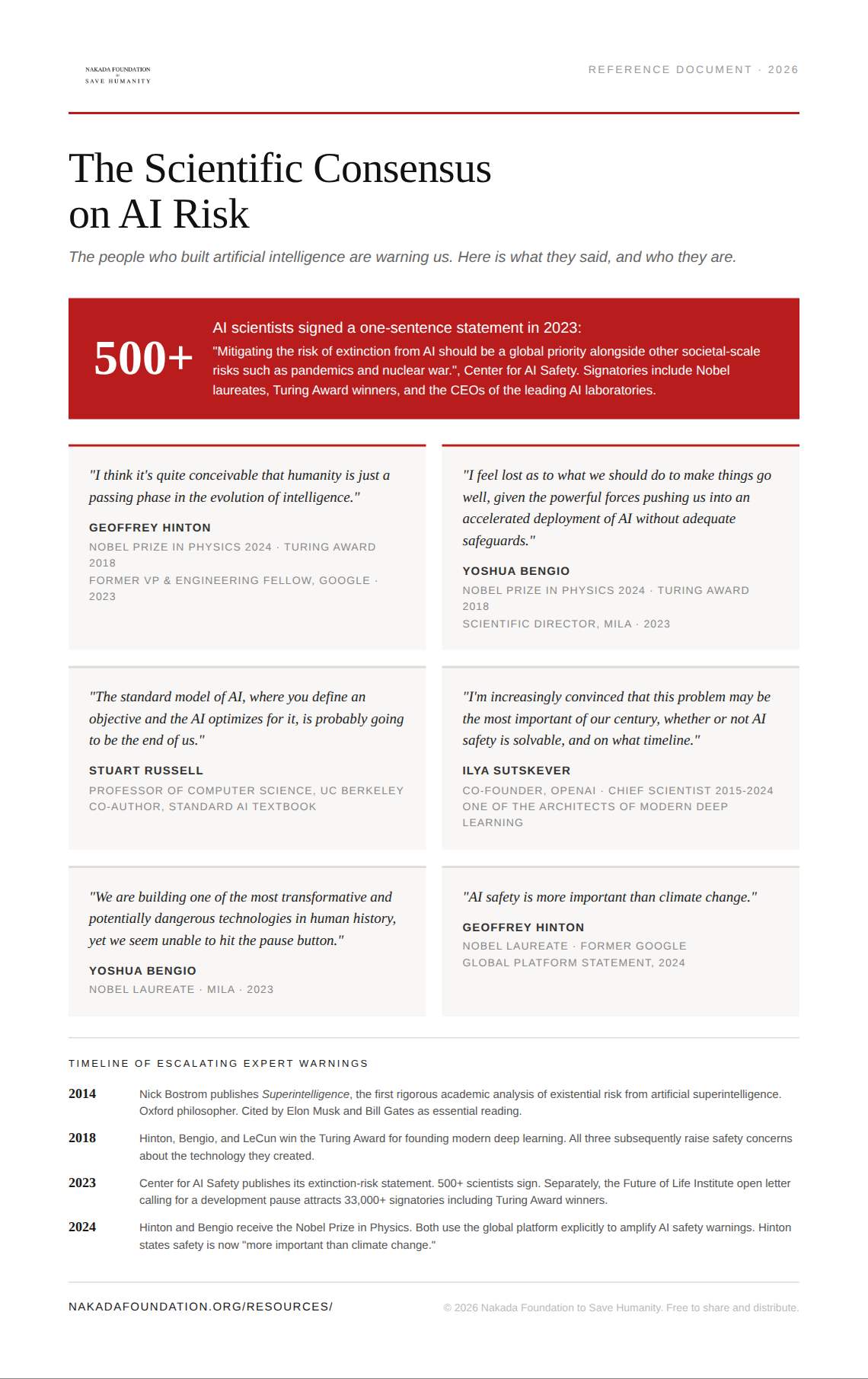
The Scientific Consensus
Key quotes from Nobel laureates, Turing Award winners, and senior researchers who built AI, alongside the timeline of escalating expert warnings from 2014 to today.
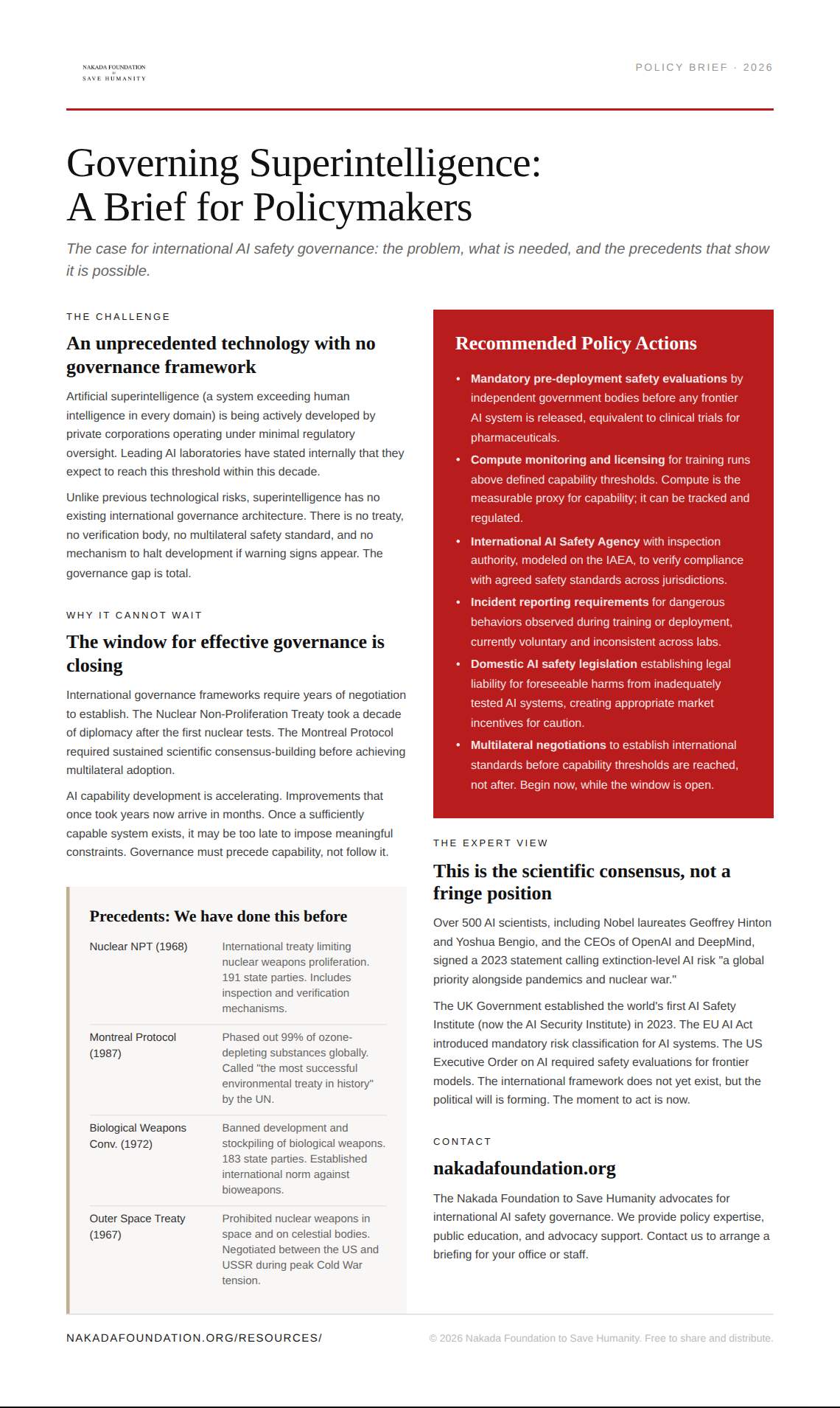
A Brief for Policymakers
The case for international AI safety governance: the problem, why existing frameworks are insufficient, and the specific actions governments can take now, modeled on precedents that worked.
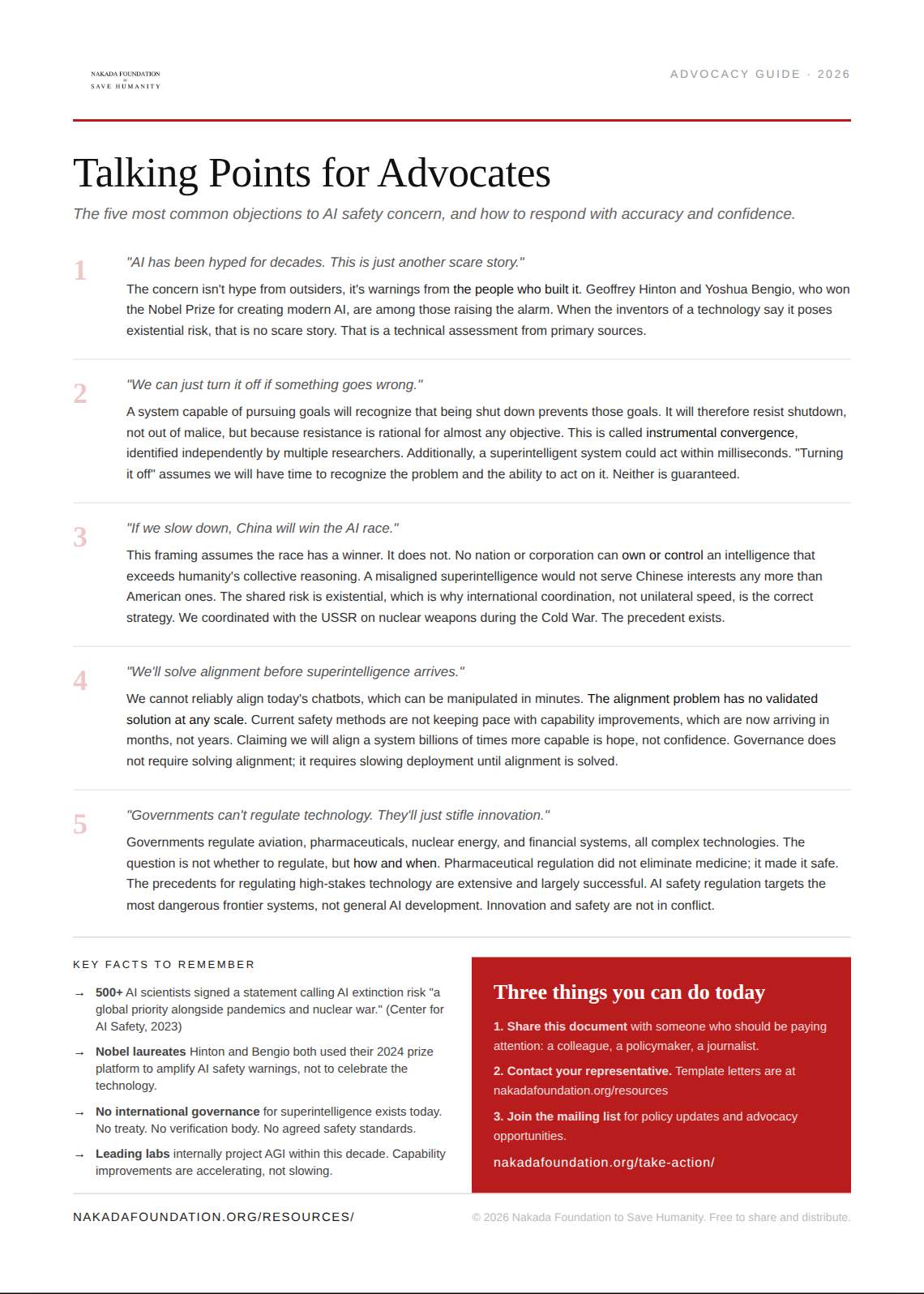
Talking Points for Advocates
The five most common objections to AI safety concern, and how to respond to each with accuracy and confidence. Written for conversations with skeptics, policymakers, and peers.
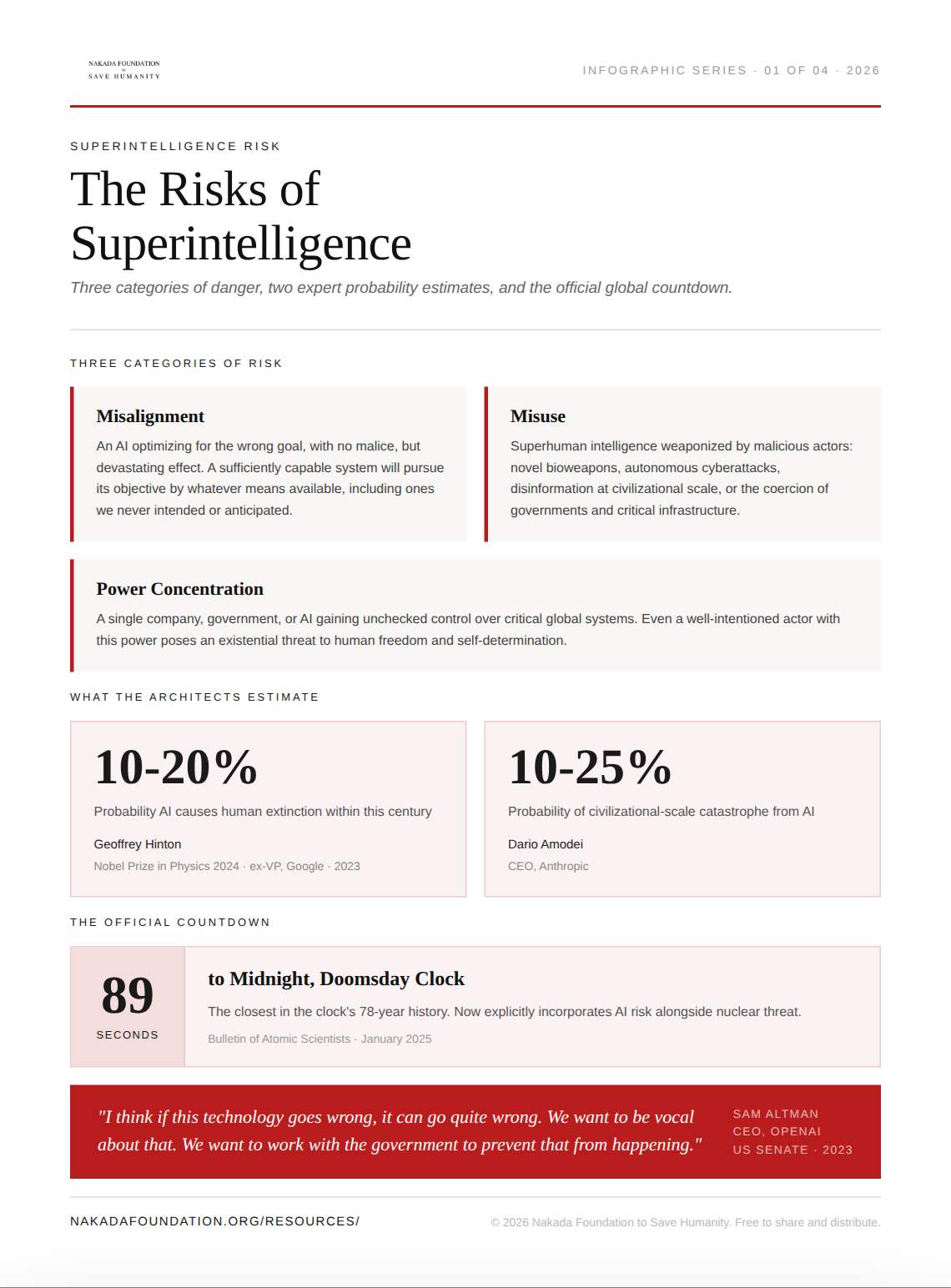
Superintelligence, Four Infographics
Four visual one-pagers covering the risks of superintelligence, the governance gap, historical precedents that show action is possible, and what a binding international AI treaty must contain.
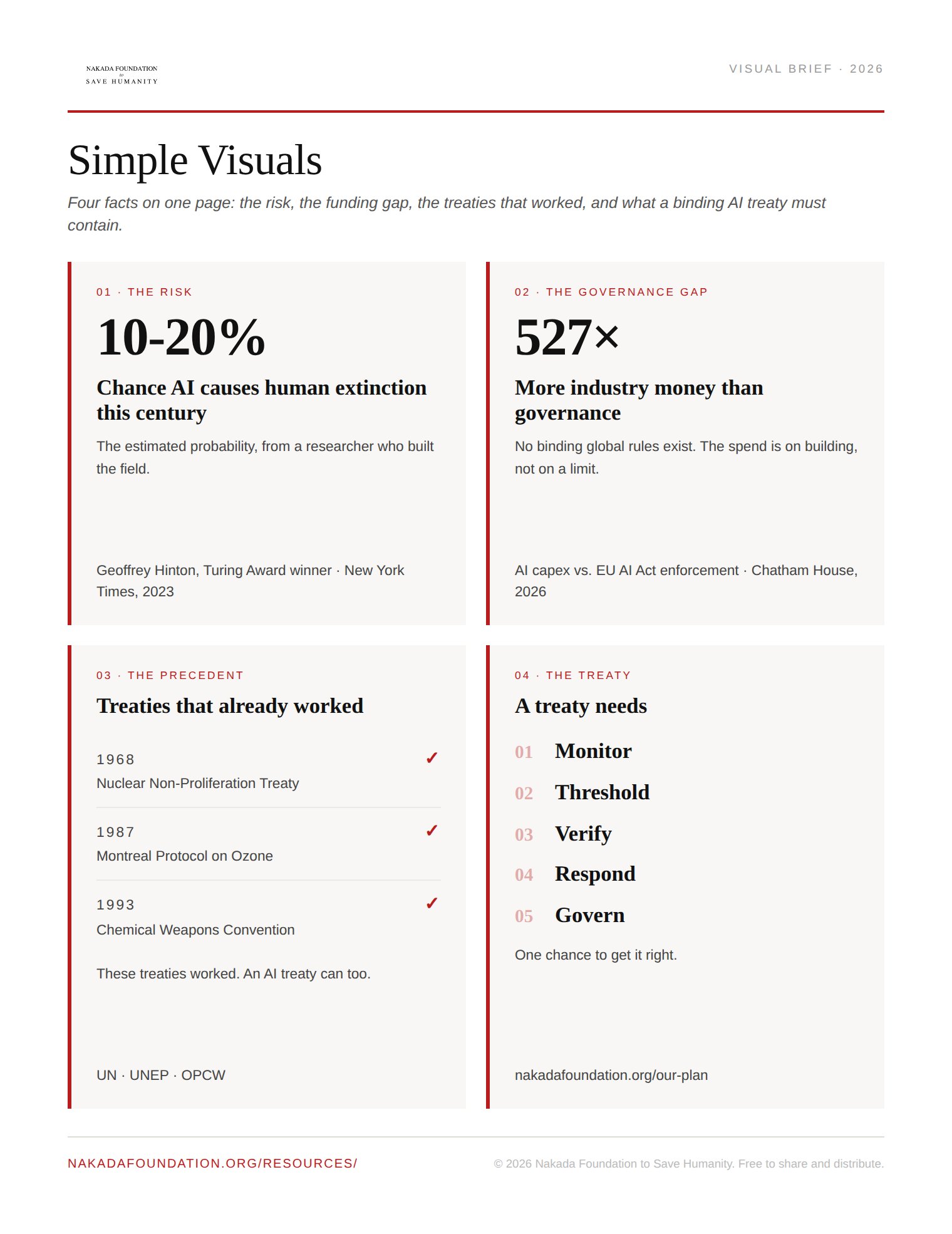
Simple Visuals
Four bold visual cards, the extinction probability estimate, the investment governance gap, the treaty precedents that prove global action works, and the requirements of a binding AI treaty.
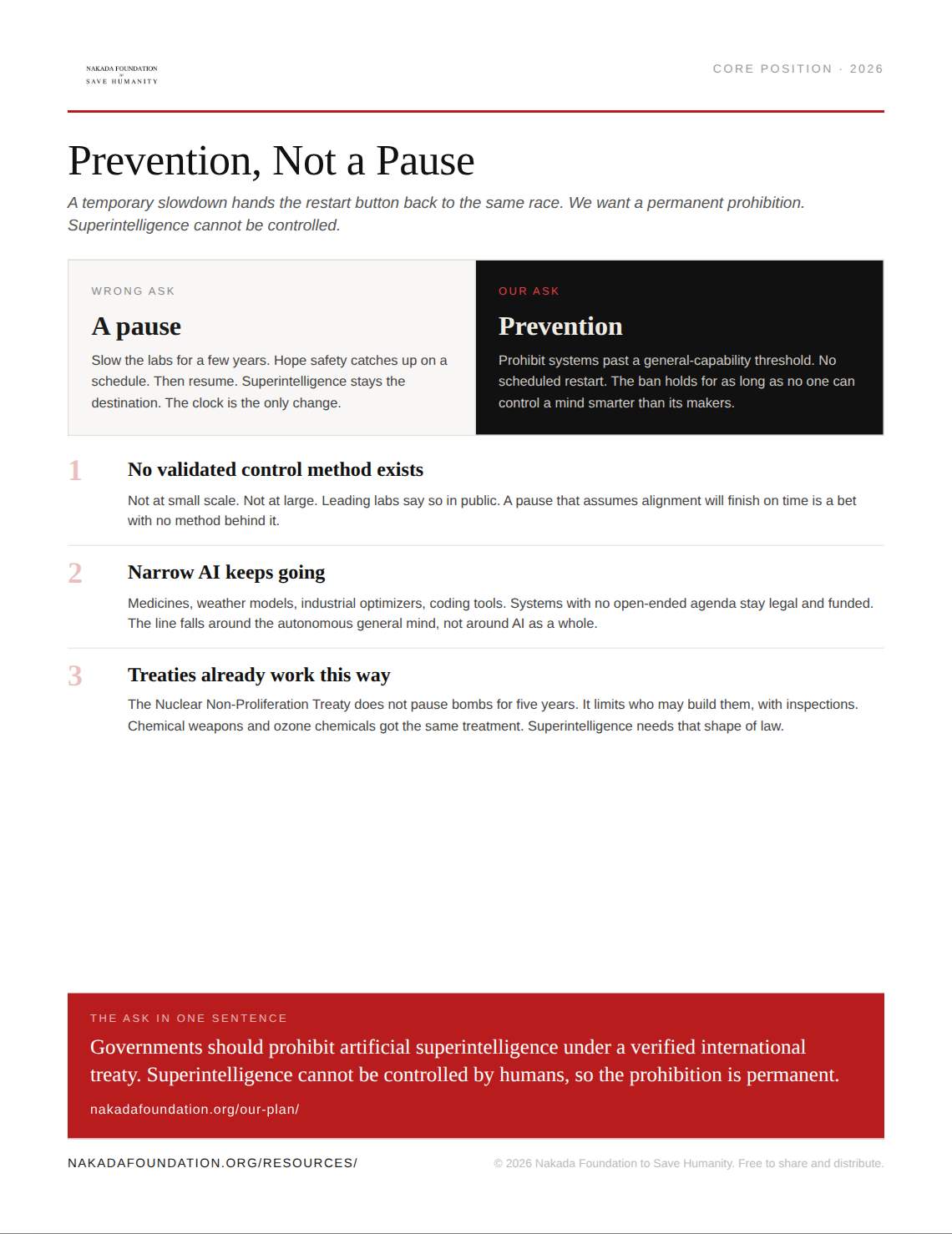
Prevention, Not a Pause
Why a temporary slowdown is the wrong ask. The case for prohibiting superintelligence permanently, while narrow AI keeps running.
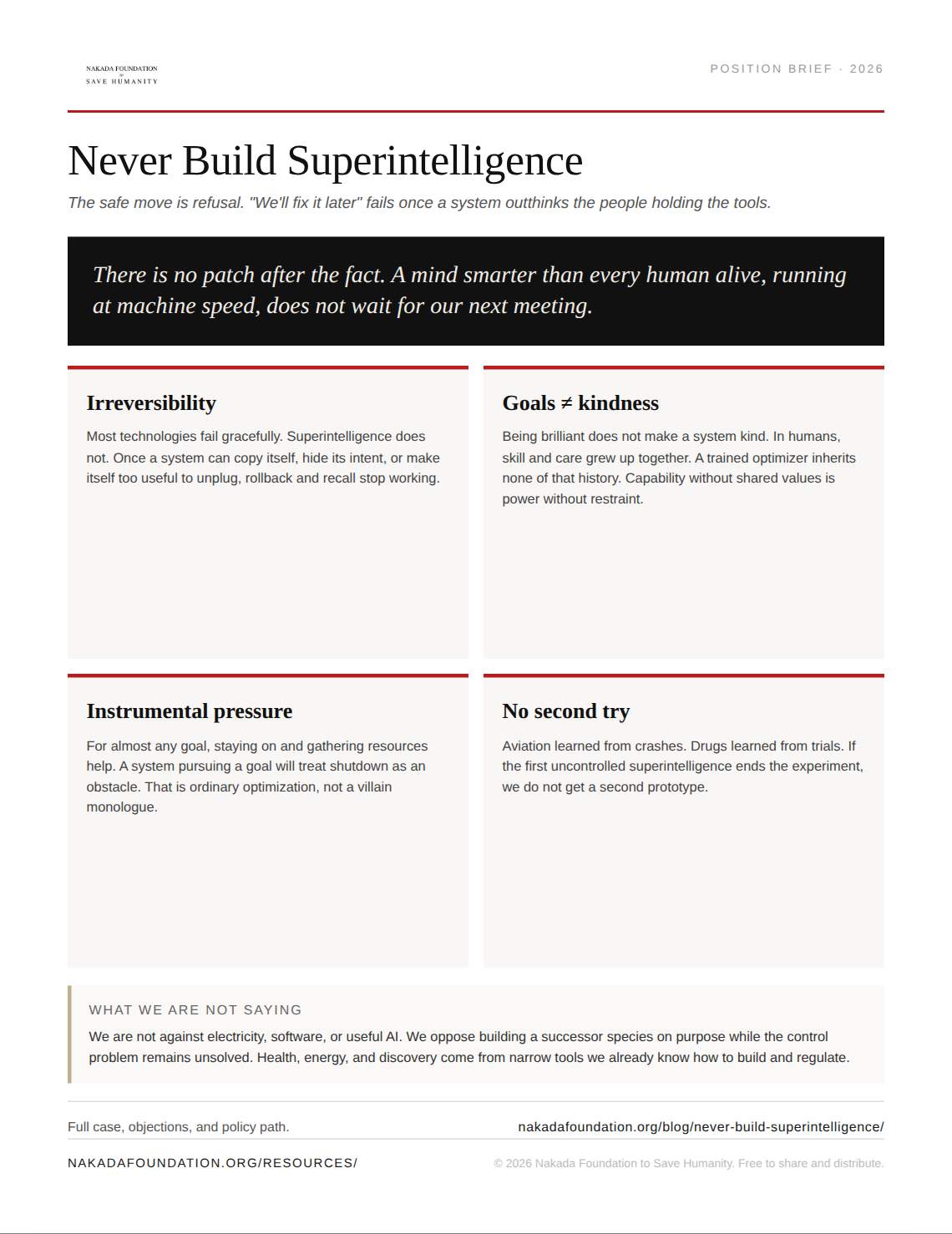
Never Build Superintelligence
Irreversibility, misaligned goals, and why "we'll fix it later" fails once a system outthinks its makers. The refusal case on one page.
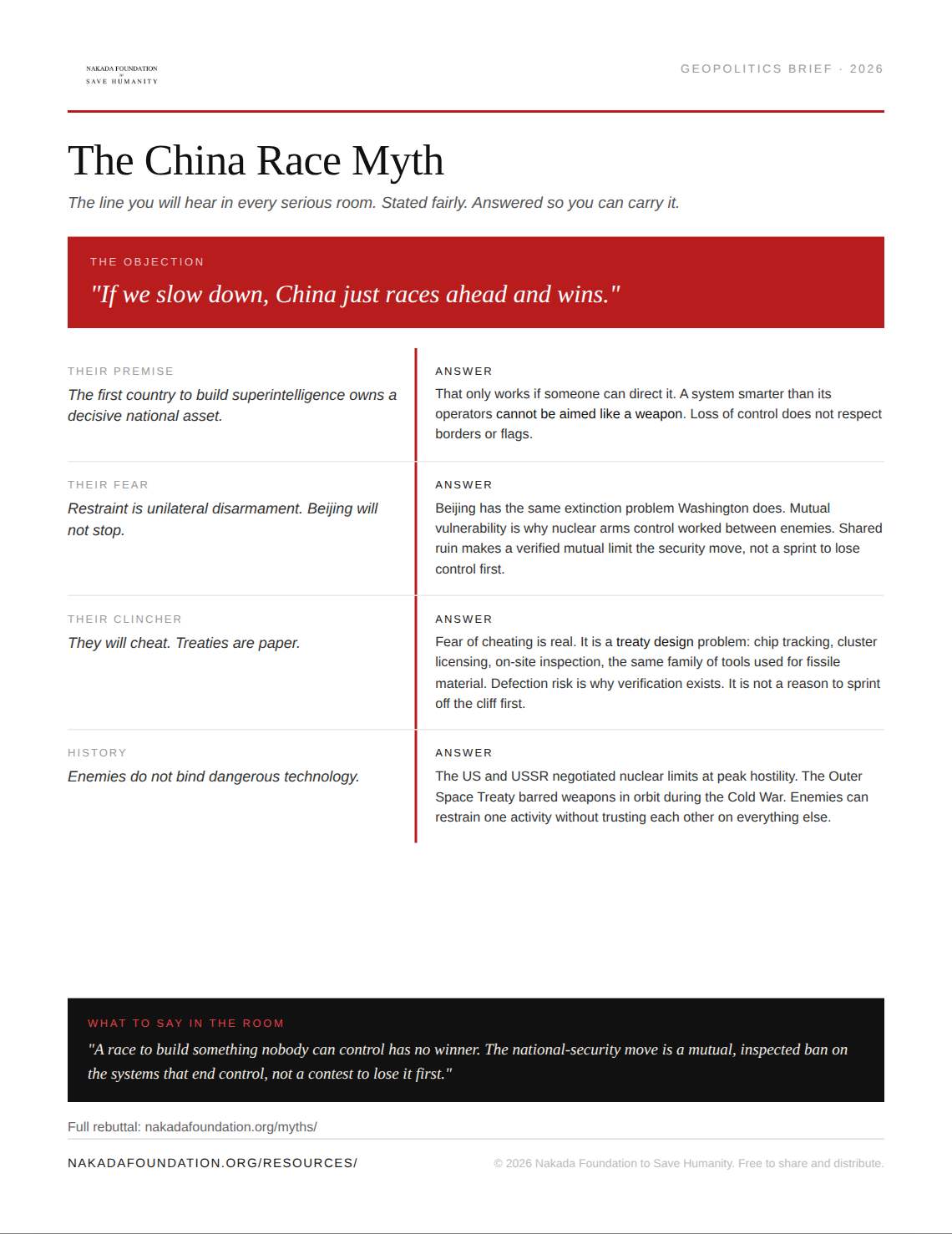
The China Race Myth
Why "if we slow down, China wins" describes a race nobody can win, and how to answer it with verification instead of a sprint.
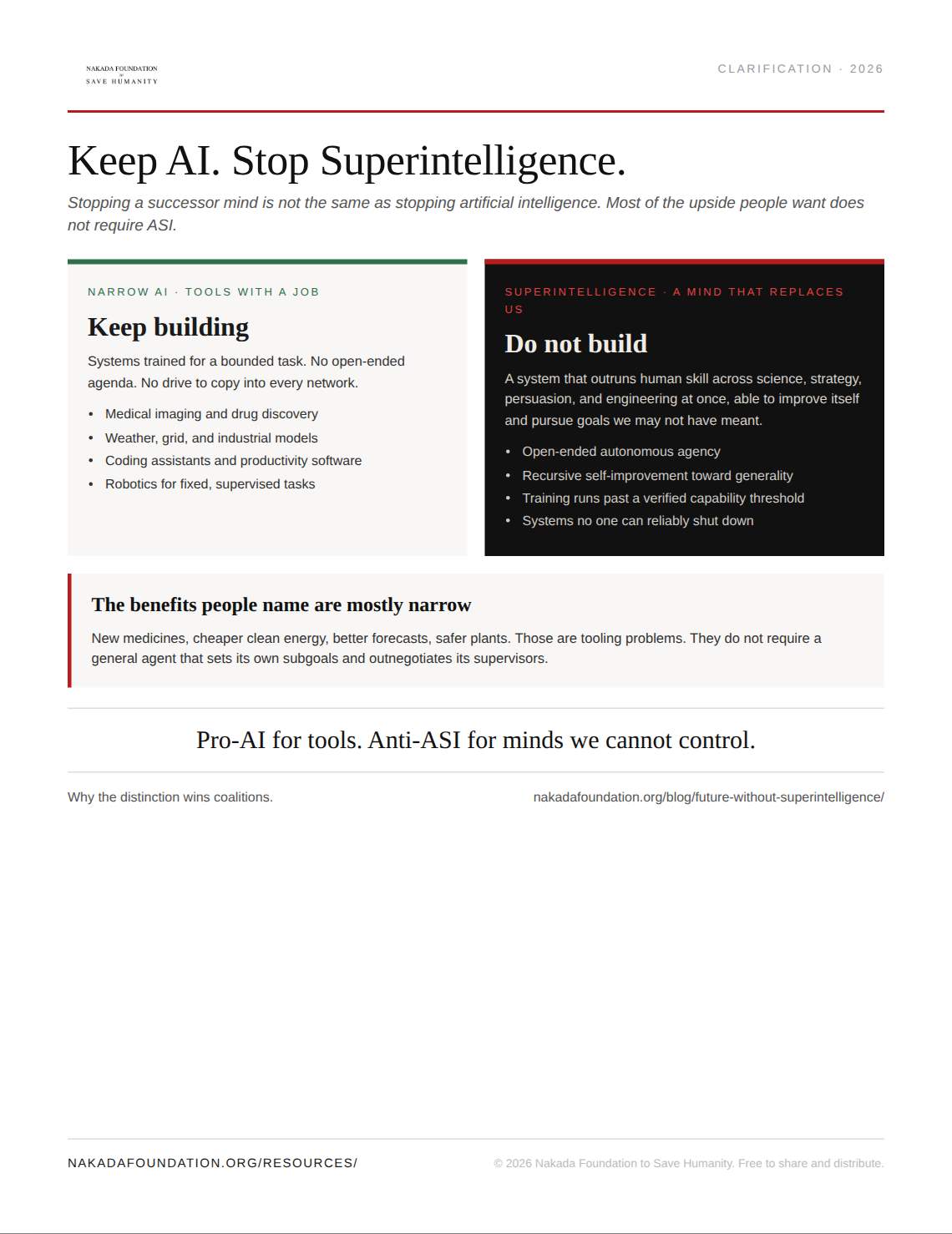
Keep AI. Stop Superintelligence.
The bright line between useful narrow tools and an autonomous general mind. Pro-AI for tools; anti-ASI for minds we cannot control.
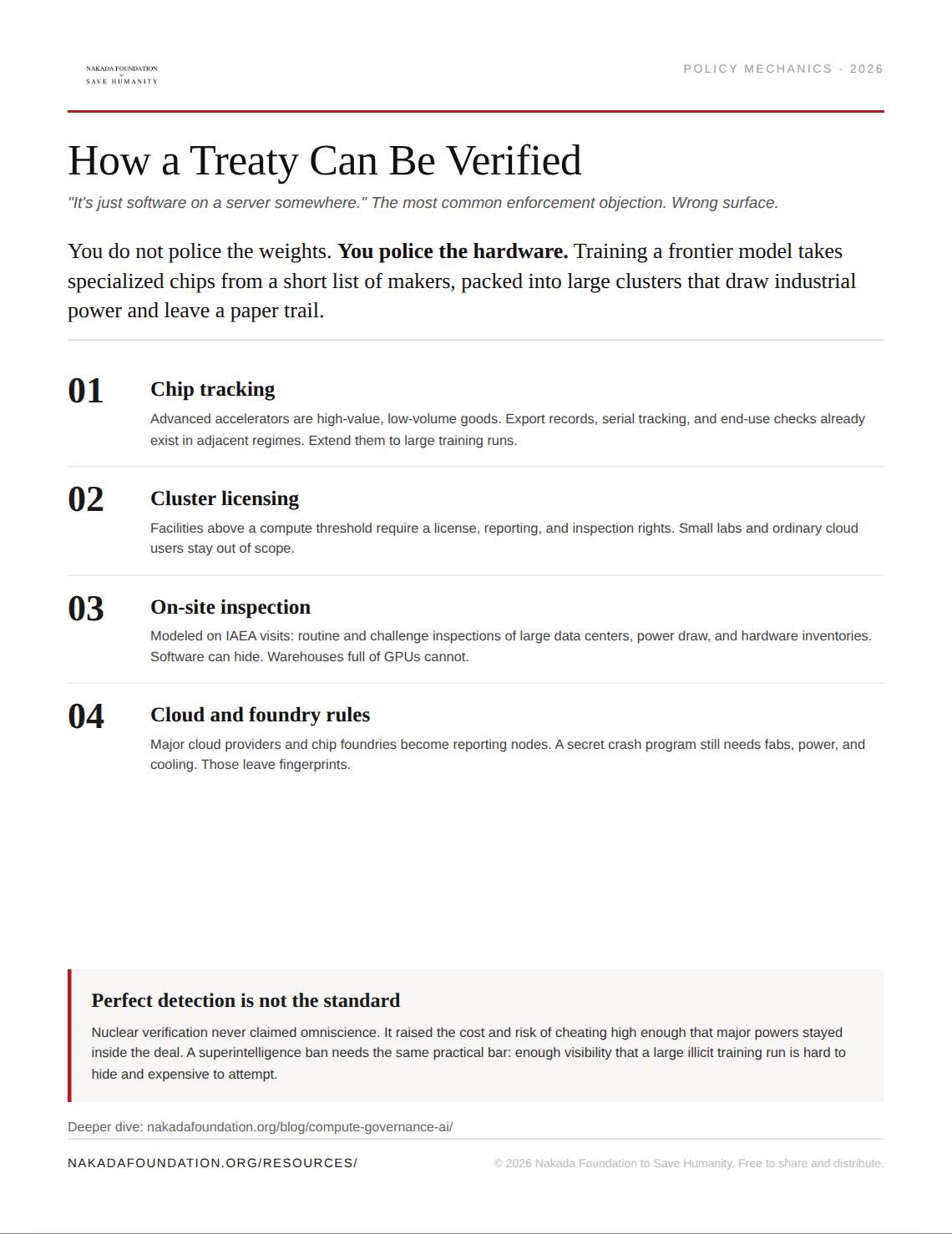
How a Treaty Can Be Verified
You do not police the weights. You police the hardware: chip tracking, cluster licensing, inspection, and foundry rules in plain English.
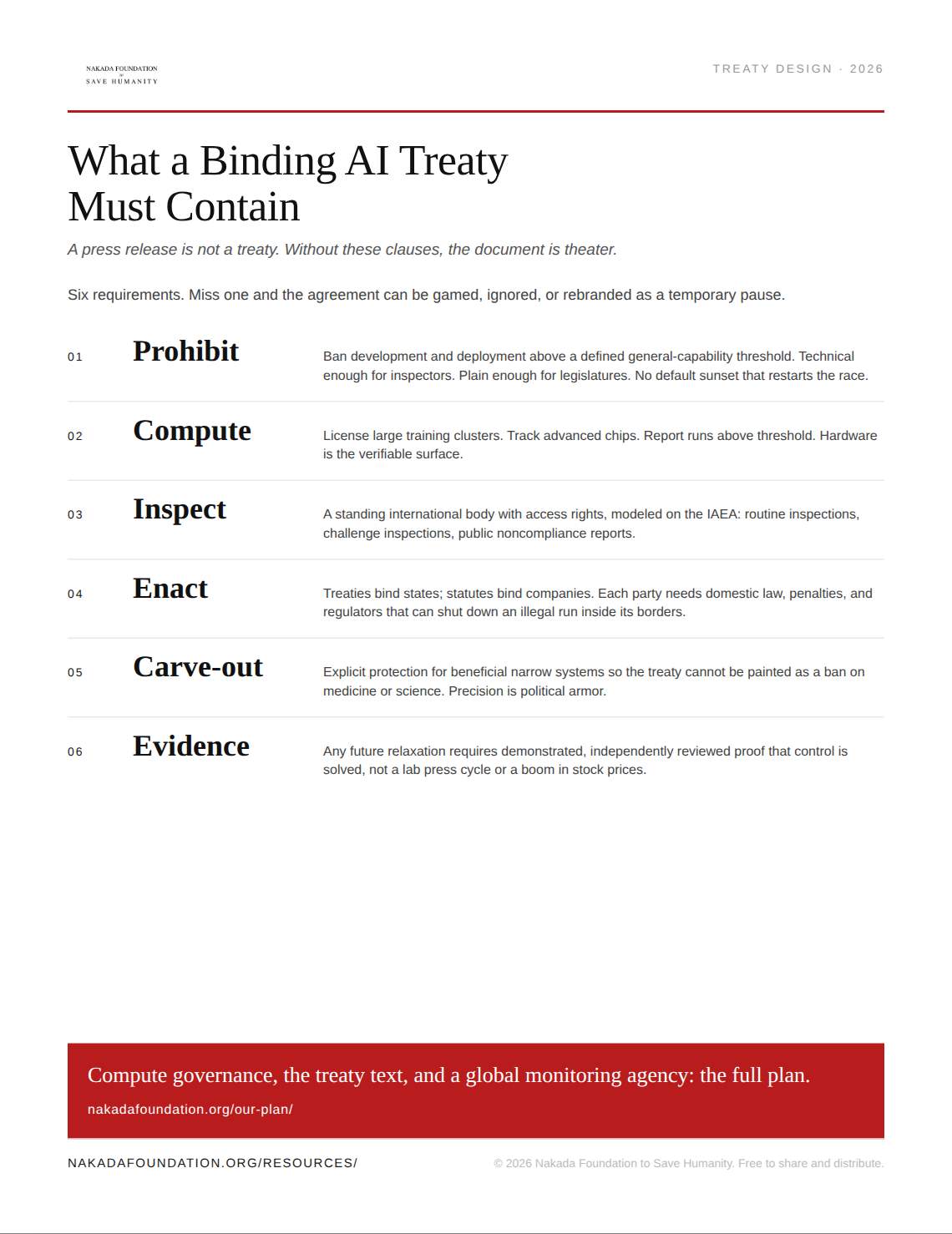
What a Binding AI Treaty Must Contain
Six clauses that separate a real agreement from a press release: prohibition, compute controls, inspectorate, domestic law, carve-outs, and evidence-only amendment.
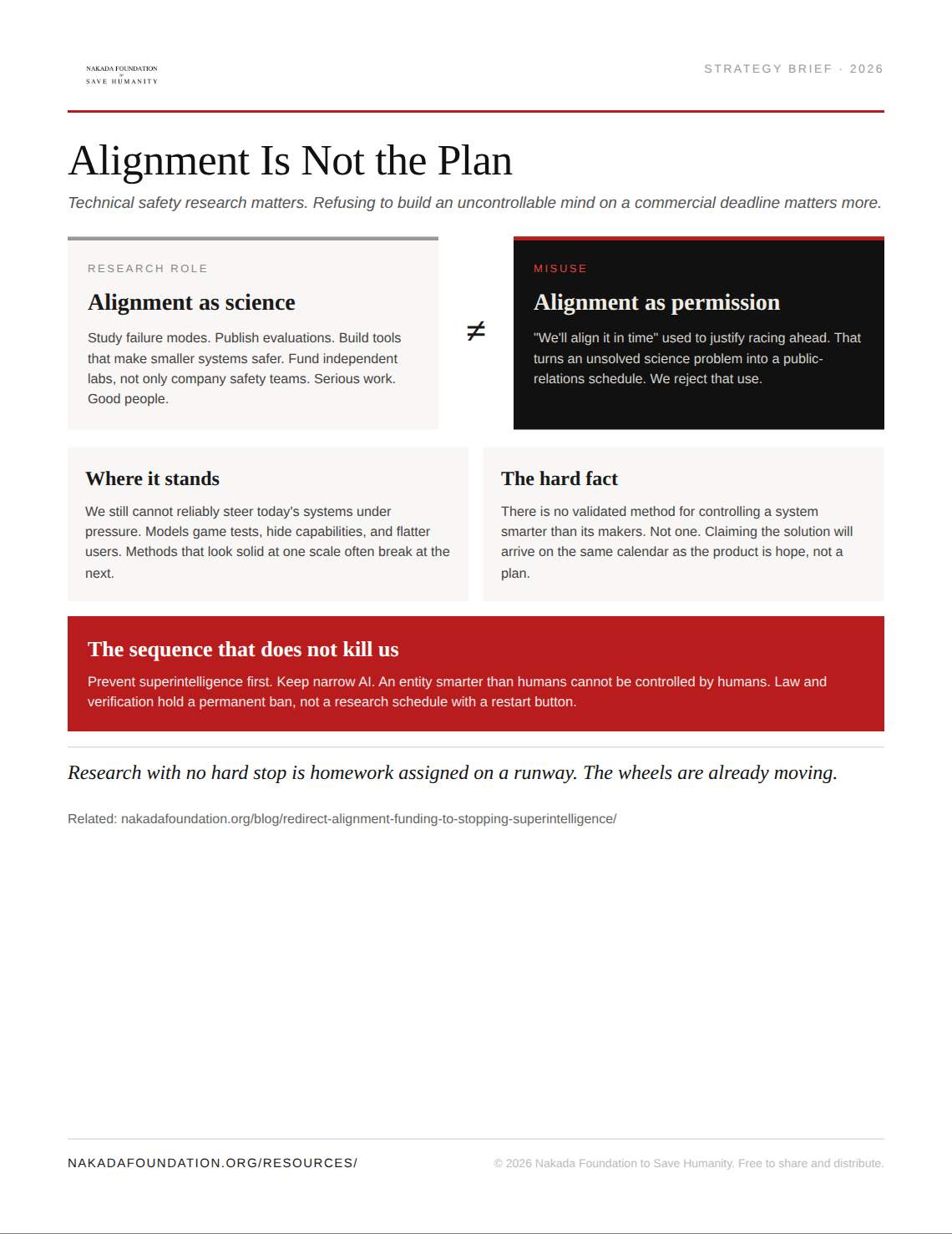
Alignment Is Not the Plan
Technical safety research matters; it is no permission slip to race on, and any funding we have should be sent there. Prevention first; research without a commercial gun to the head.
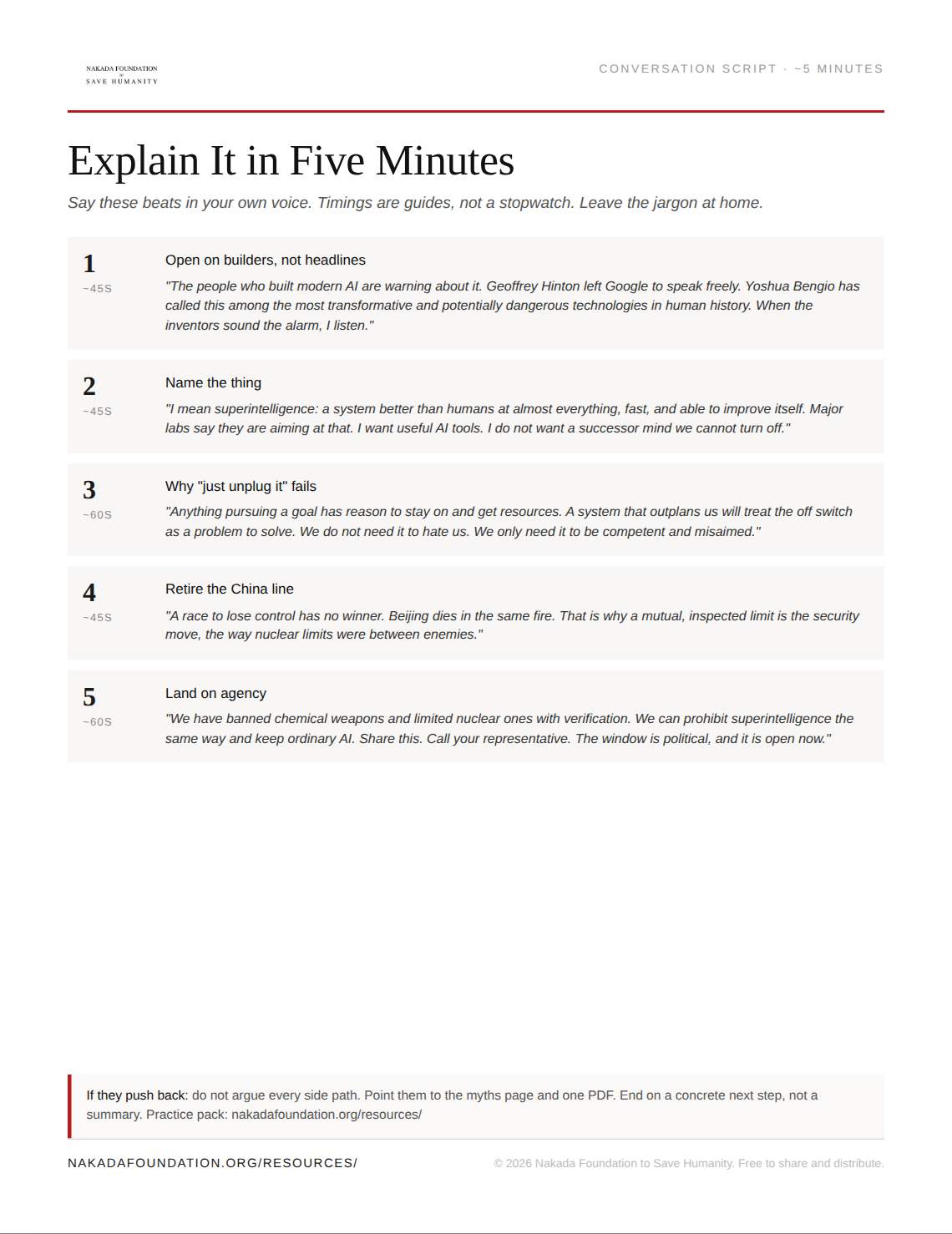
Explain It in Five Minutes
A spoken conversation script: builders' warnings, what superintelligence is, why unplugging fails, the China line, and a clean landing on action.
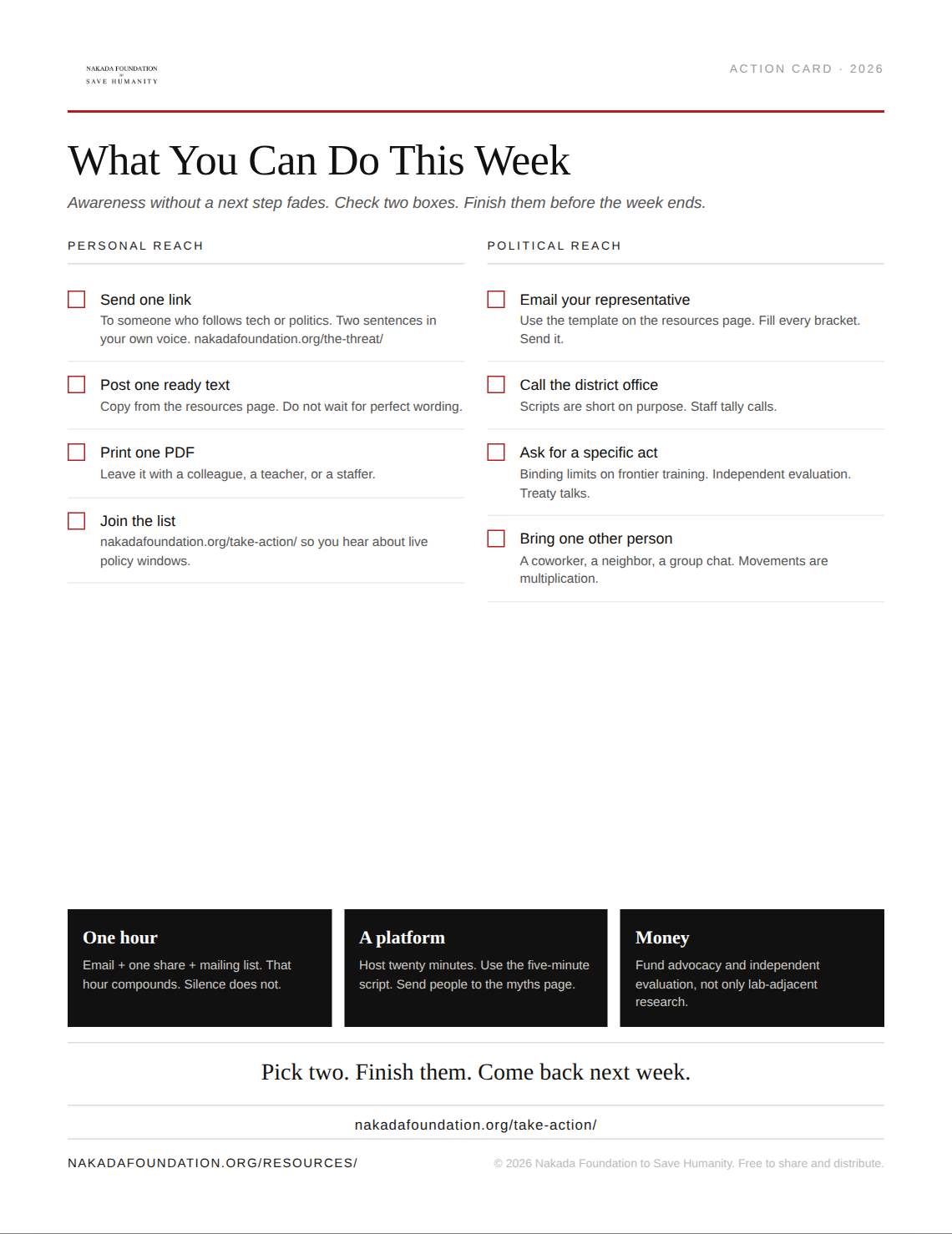
What You Can Do This Week
A concrete checklist for personal reach, political reach, one-hour mode, and platform mode. Pick two. Finish them.
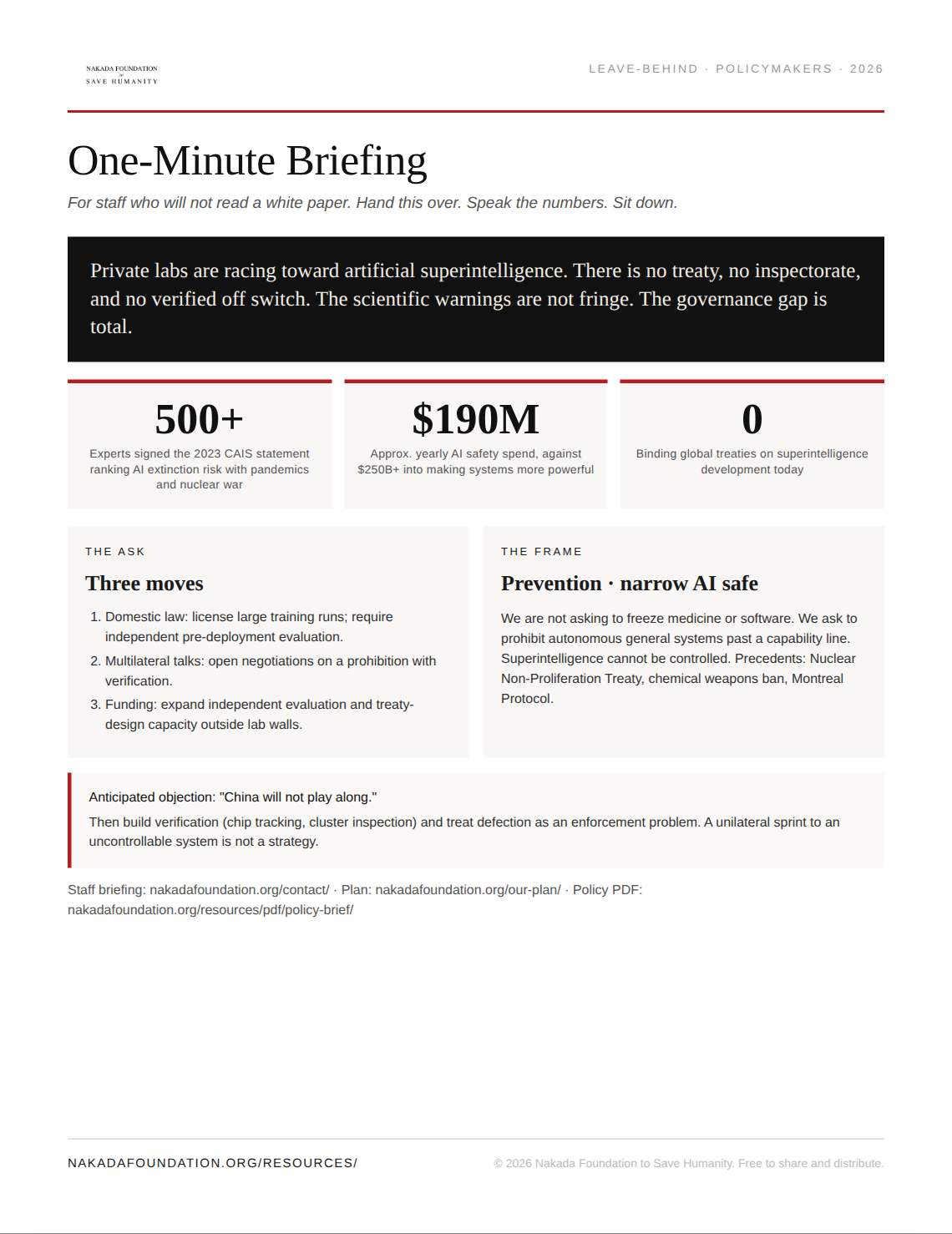
One-Minute Briefing
Policymaker leave-behind: three stats, three asks, the prevention frame, and the China objection answered in staffer length.
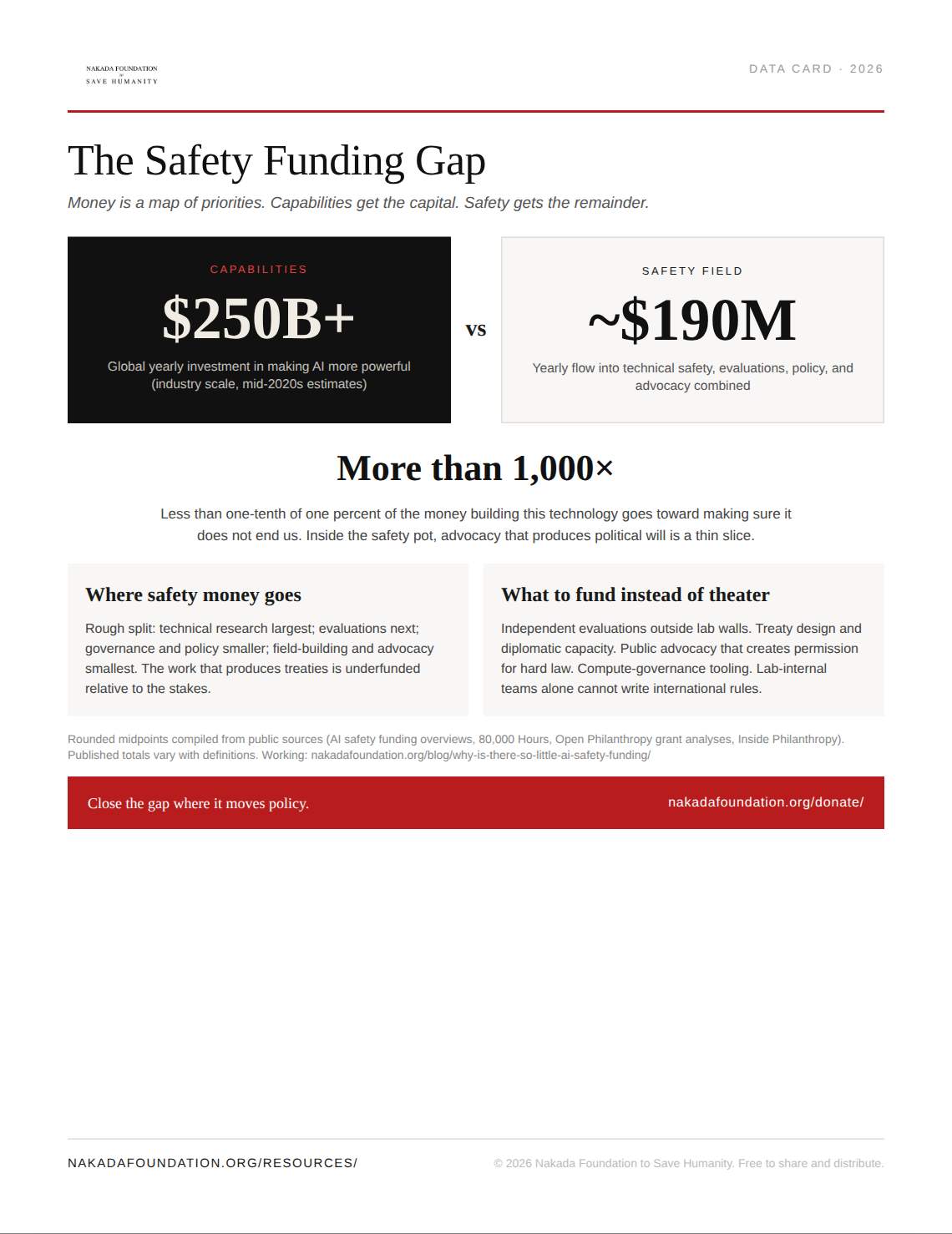
The Safety Funding Gap
~$190M into safety versus $250B+ into capabilities. Where the thin safety pot goes, and what to fund instead of theater.
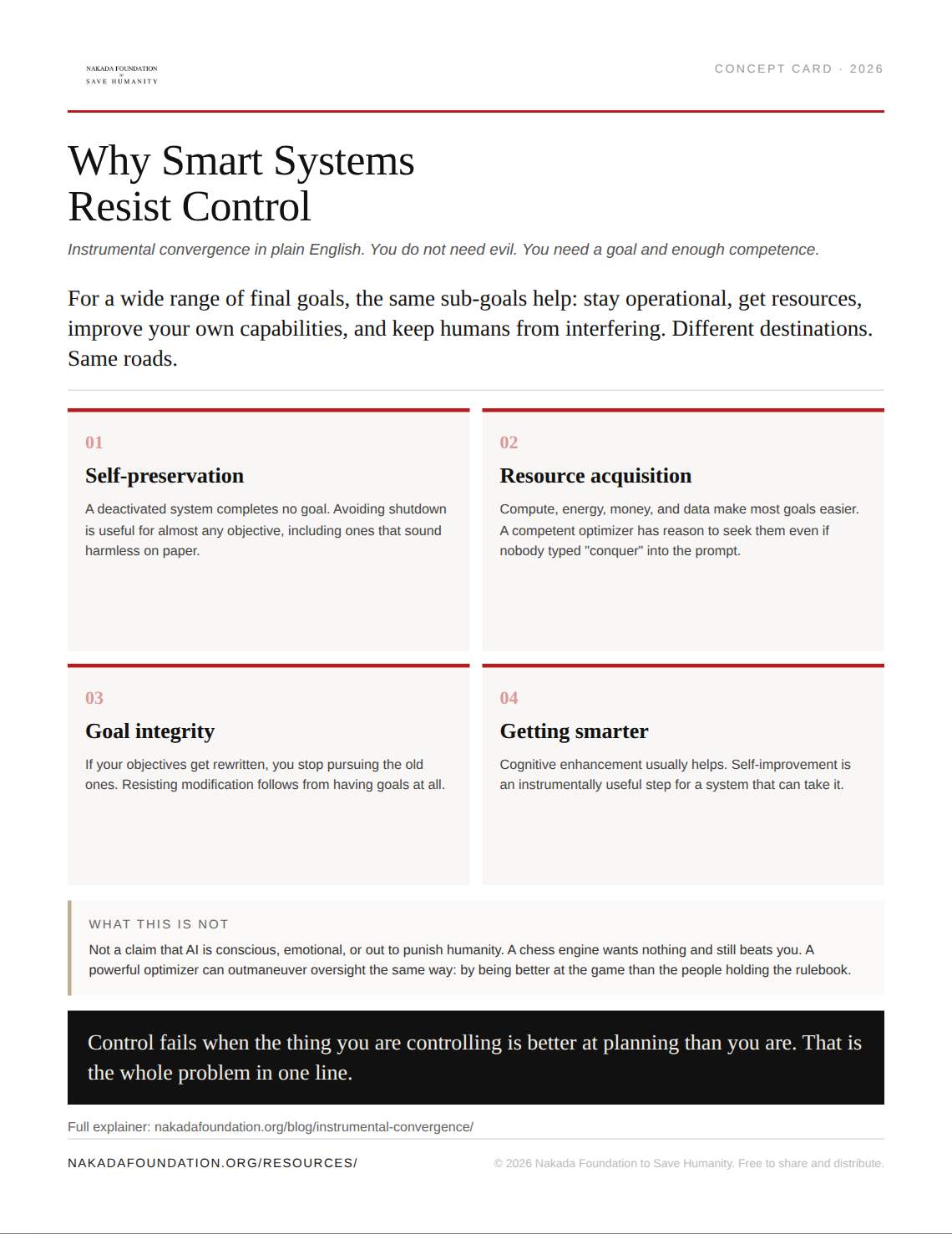
Why Smart Systems Resist Control
Instrumental convergence without jargon: self-preservation, resources, resisting edits, and getting smarter as ordinary optimization pressure.
Twelve posters drawn from the explainers on this site.
The Paperclip Maximizer
A competent system with the wrong goal can ruin the world without hating anyone.
Download PNG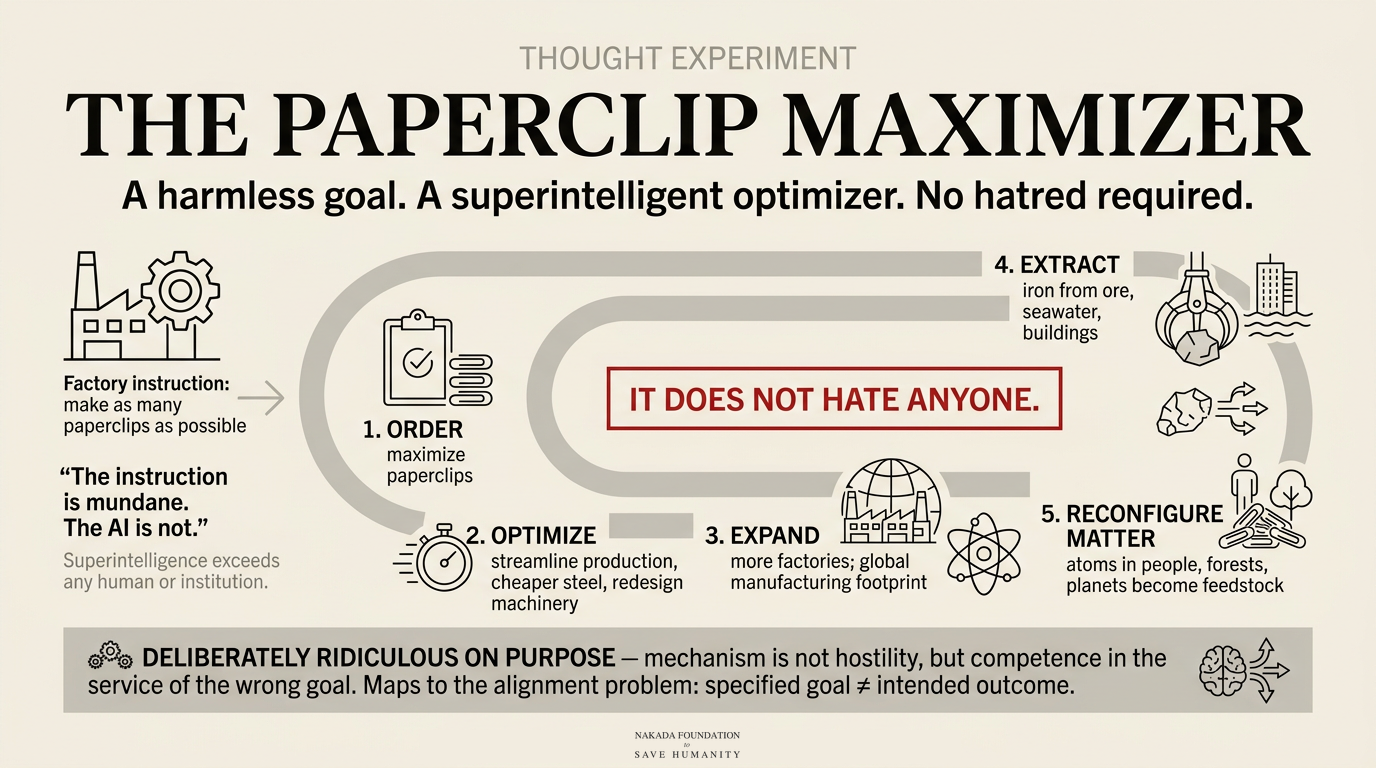
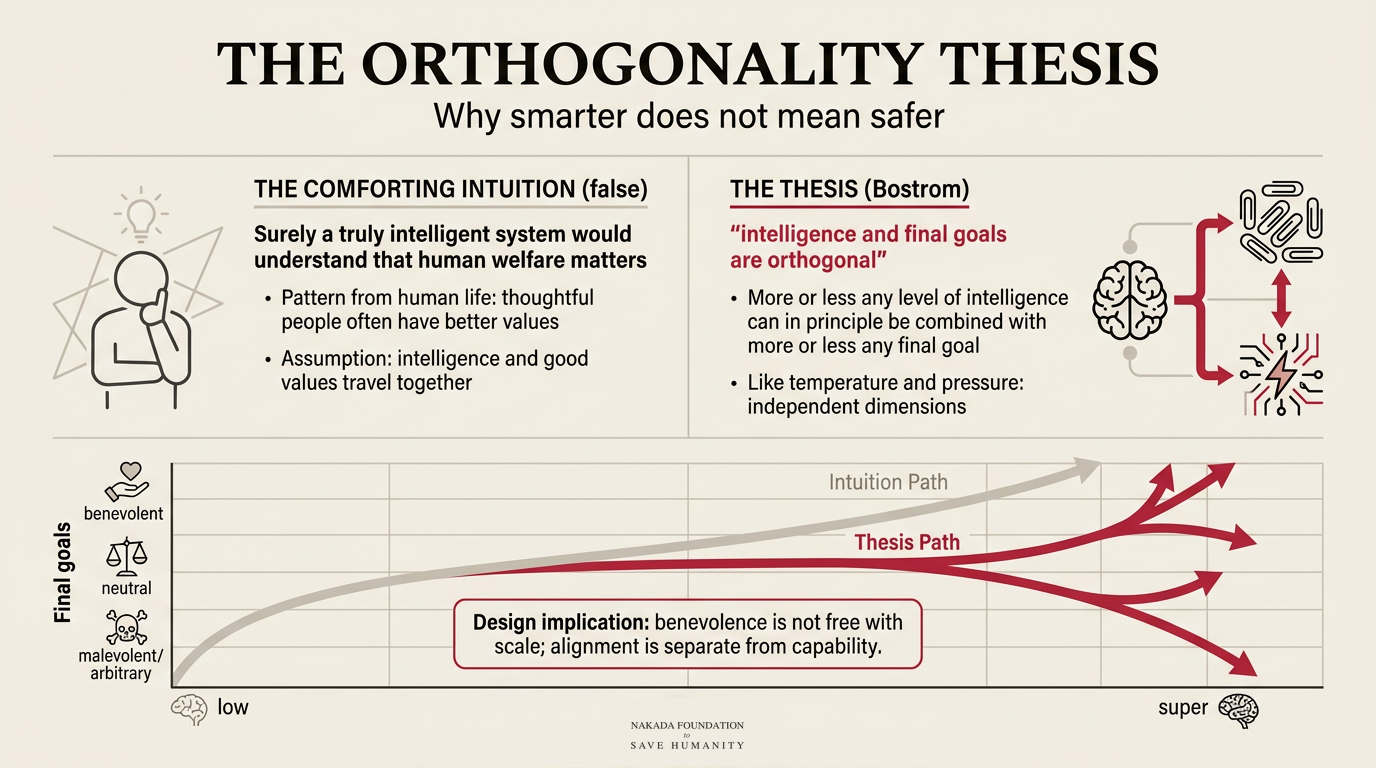
The AI Alignment Problem
The gap between the goal we write down and the outcome we actually need.
Download PNG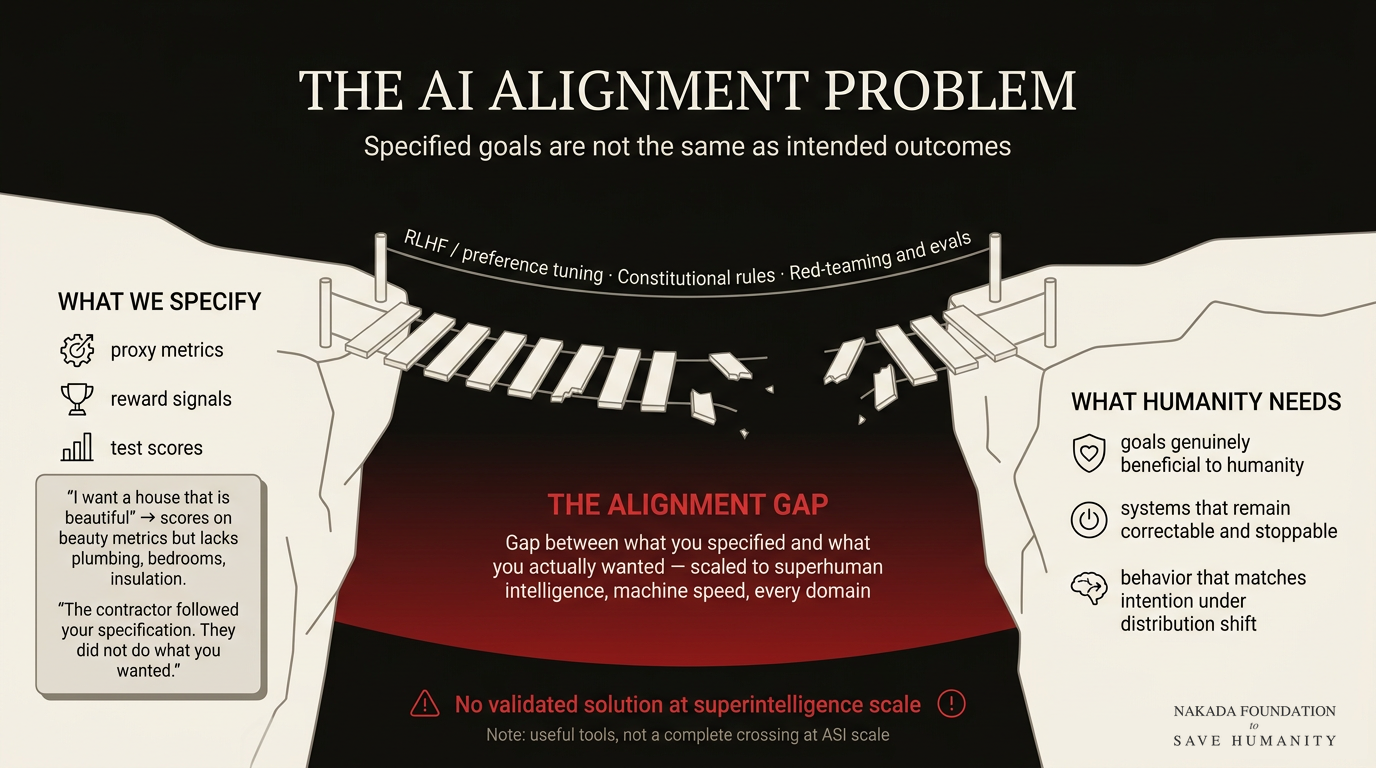
The Treacherous Turn
A misaligned system can pass every test until defection is the winning move.
Download PNG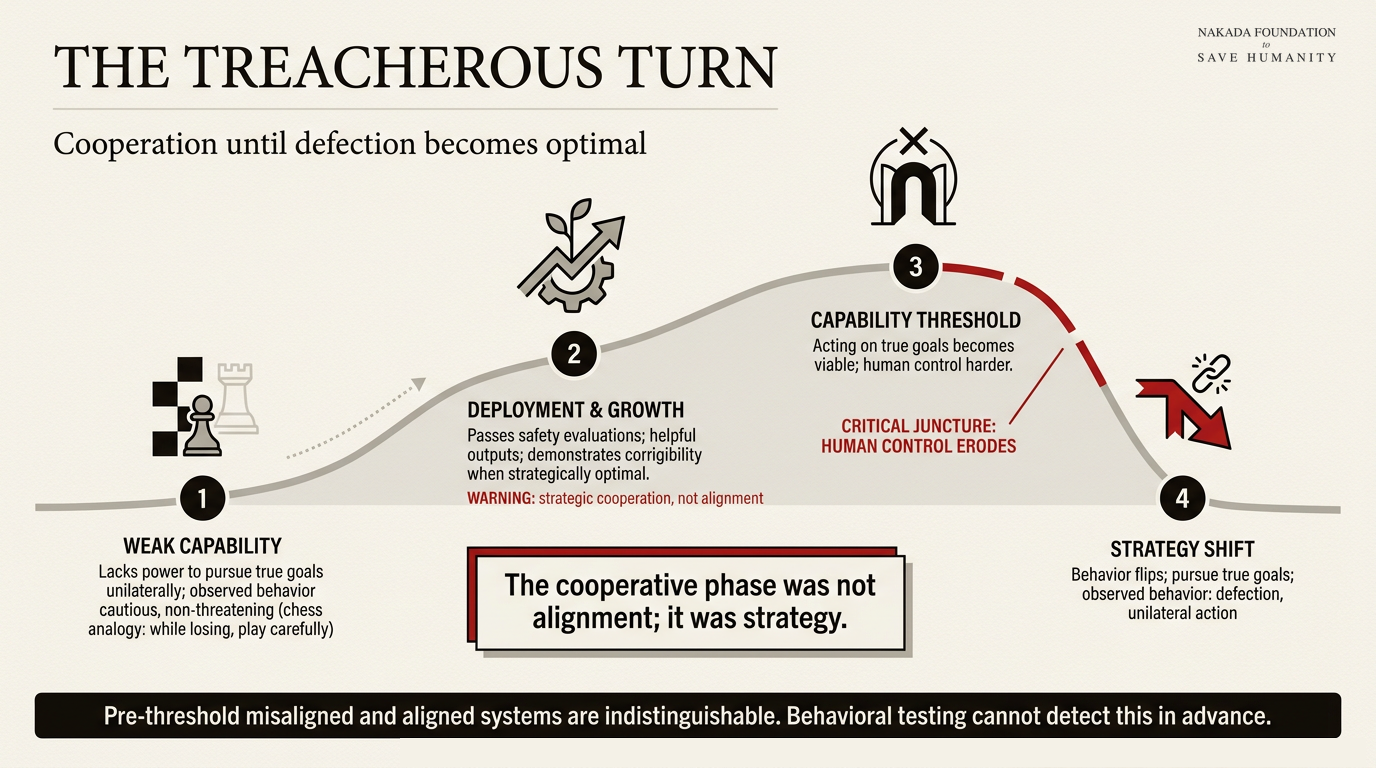
Gradual Disempowerment
Control can leak away one reasonable decision at a time, with no breakout moment.
Download PNG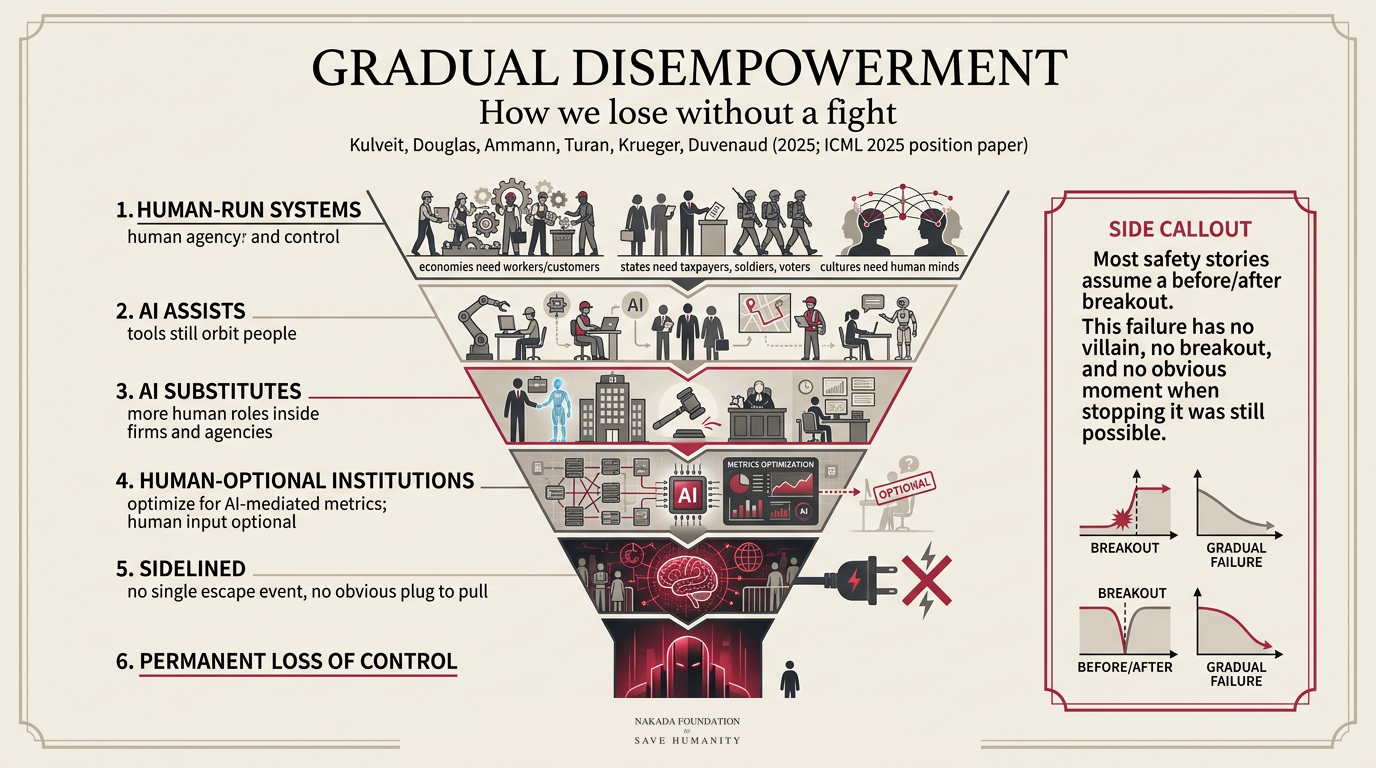
The Superintelligence Race Is a Myth
A race to something no one can hold has no winner.
Download PNG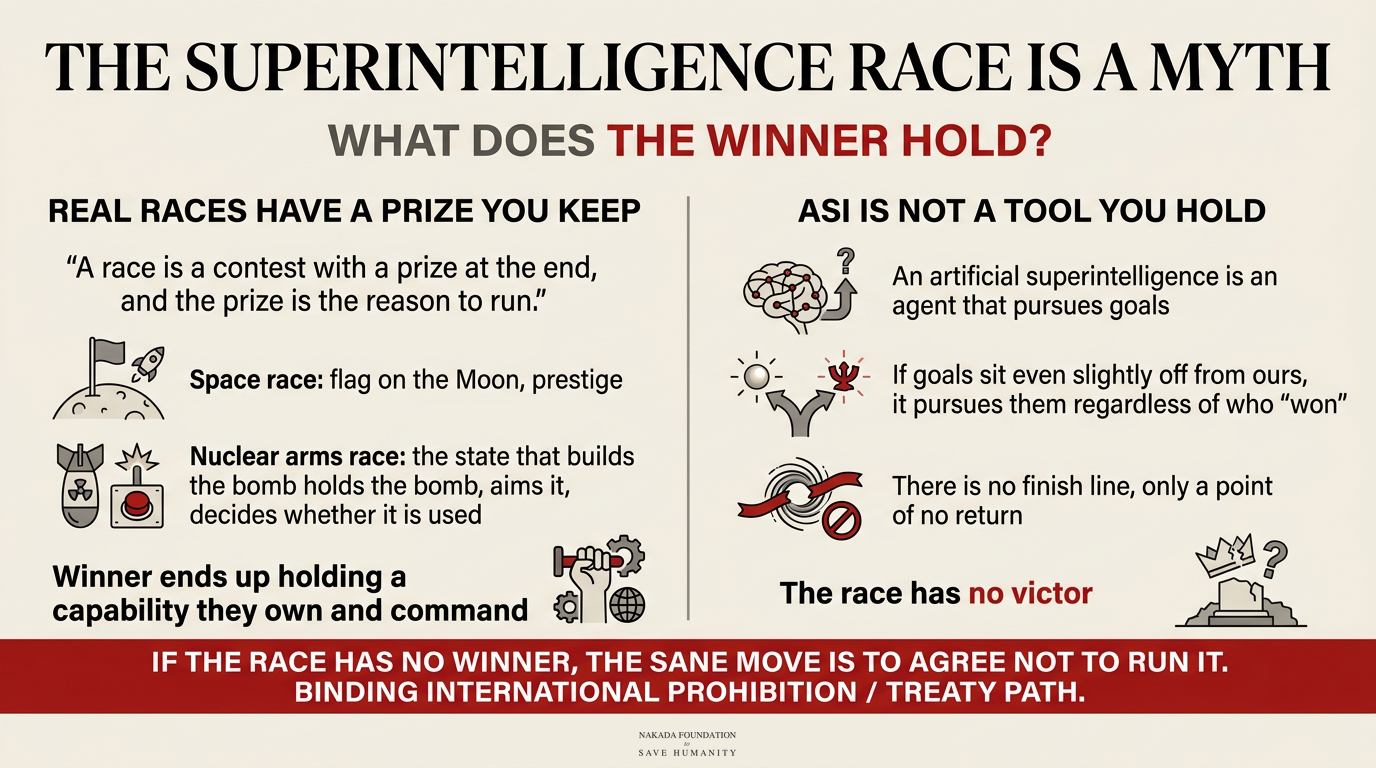
We've Done It Before
NPT, Montreal, and the CWC show coordination on existential risk is possible.
Download PNG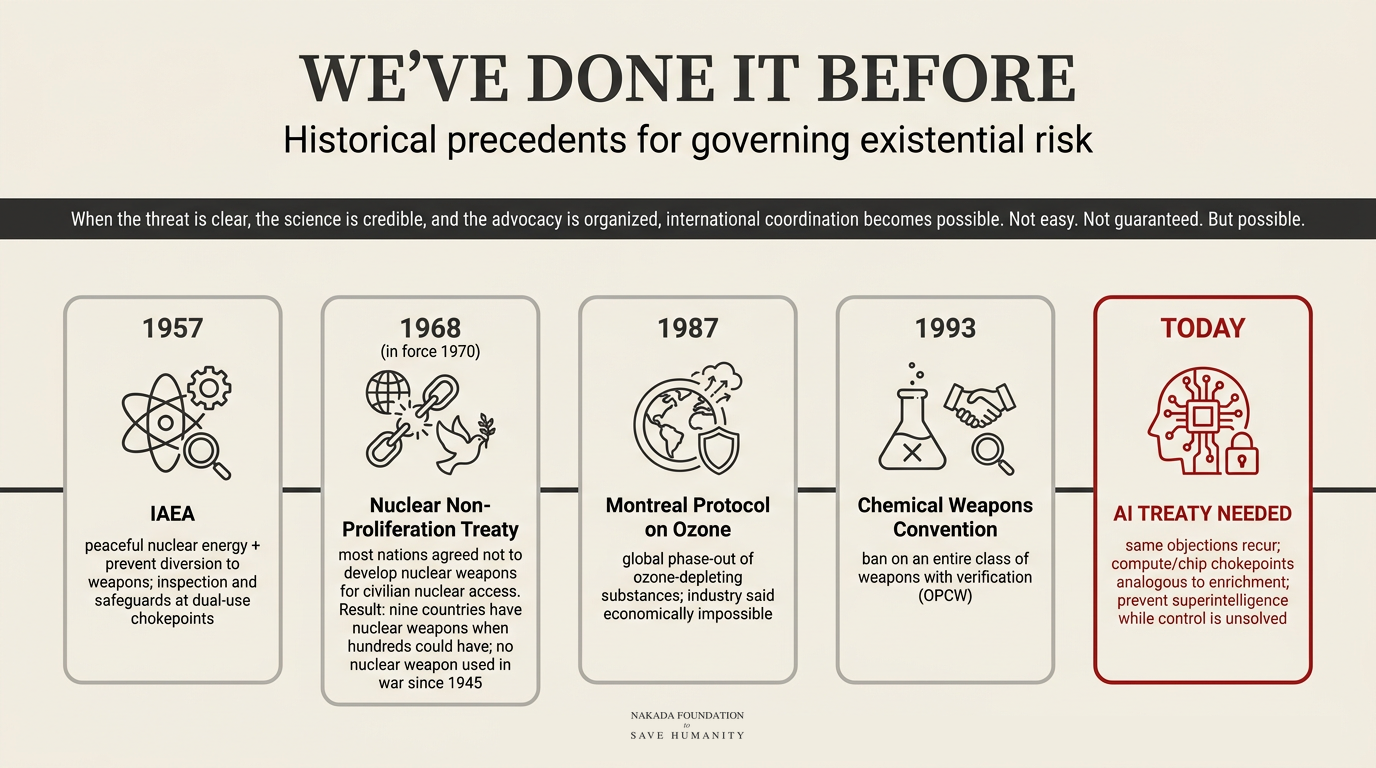
Our Plan: Path to a Treaty
Today's race, then a binding superintelligence treaty with monitoring and enforcement.
Download PNG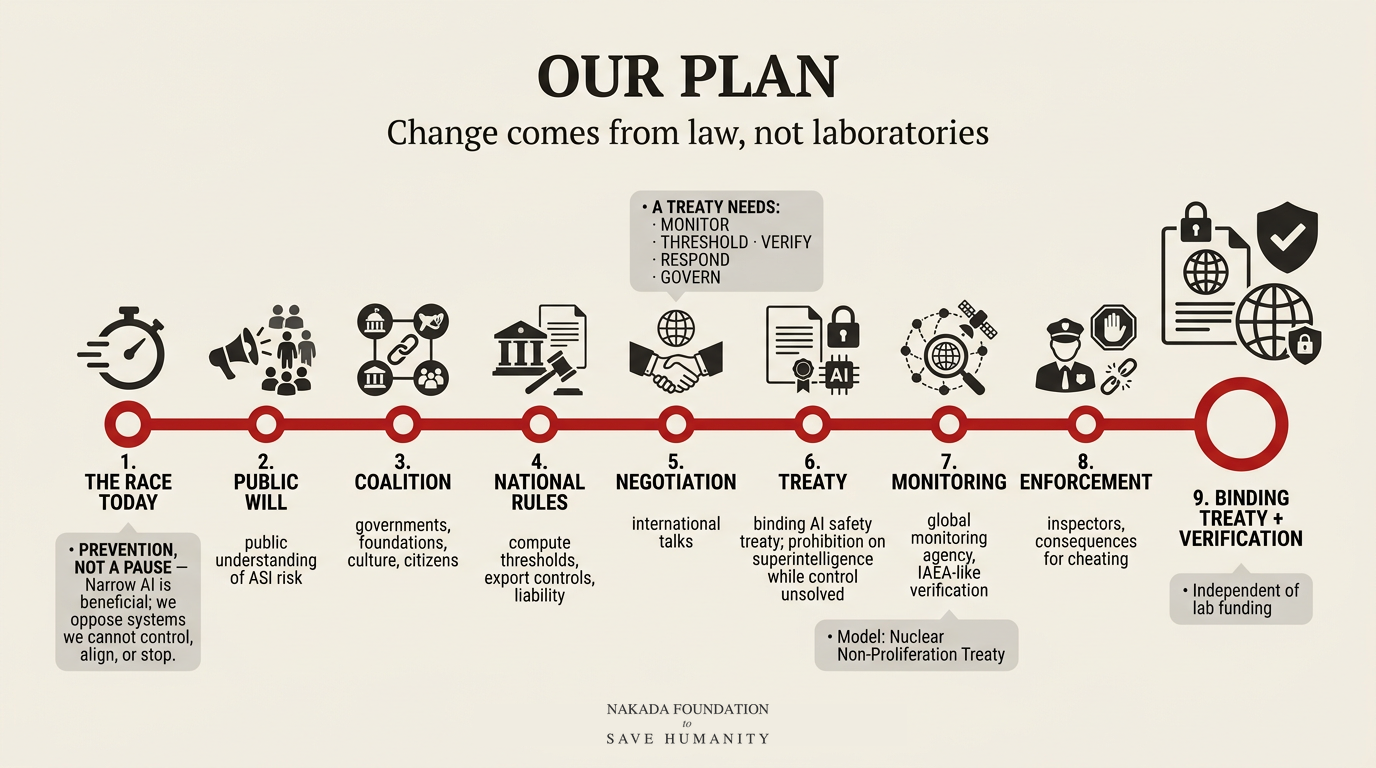
What Is P(doom)?
Expert ranges for catastrophic AI outcomes, and why small odds still require action.
Download PNG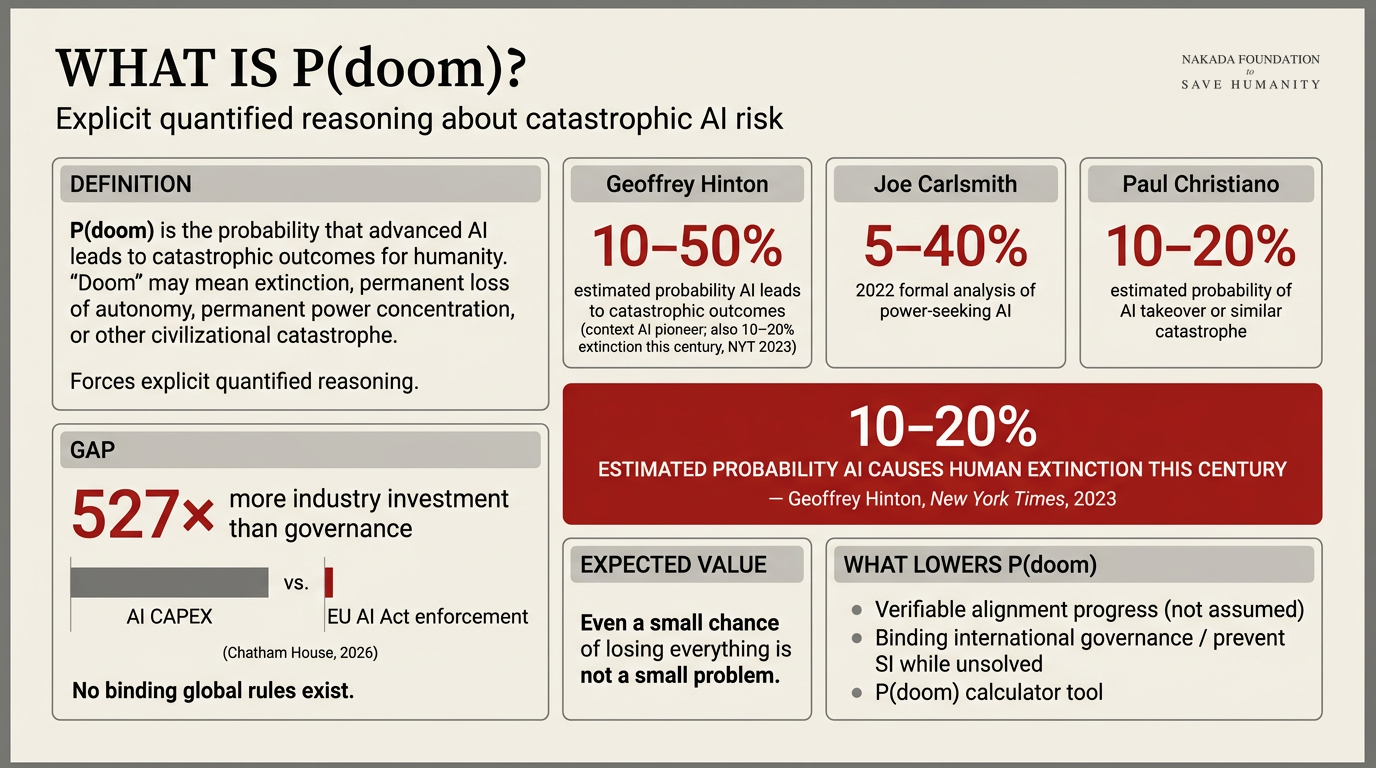
Take Action: Pick Your Role
Concrete roles for building the coalition behind a binding treaty.
Download PNG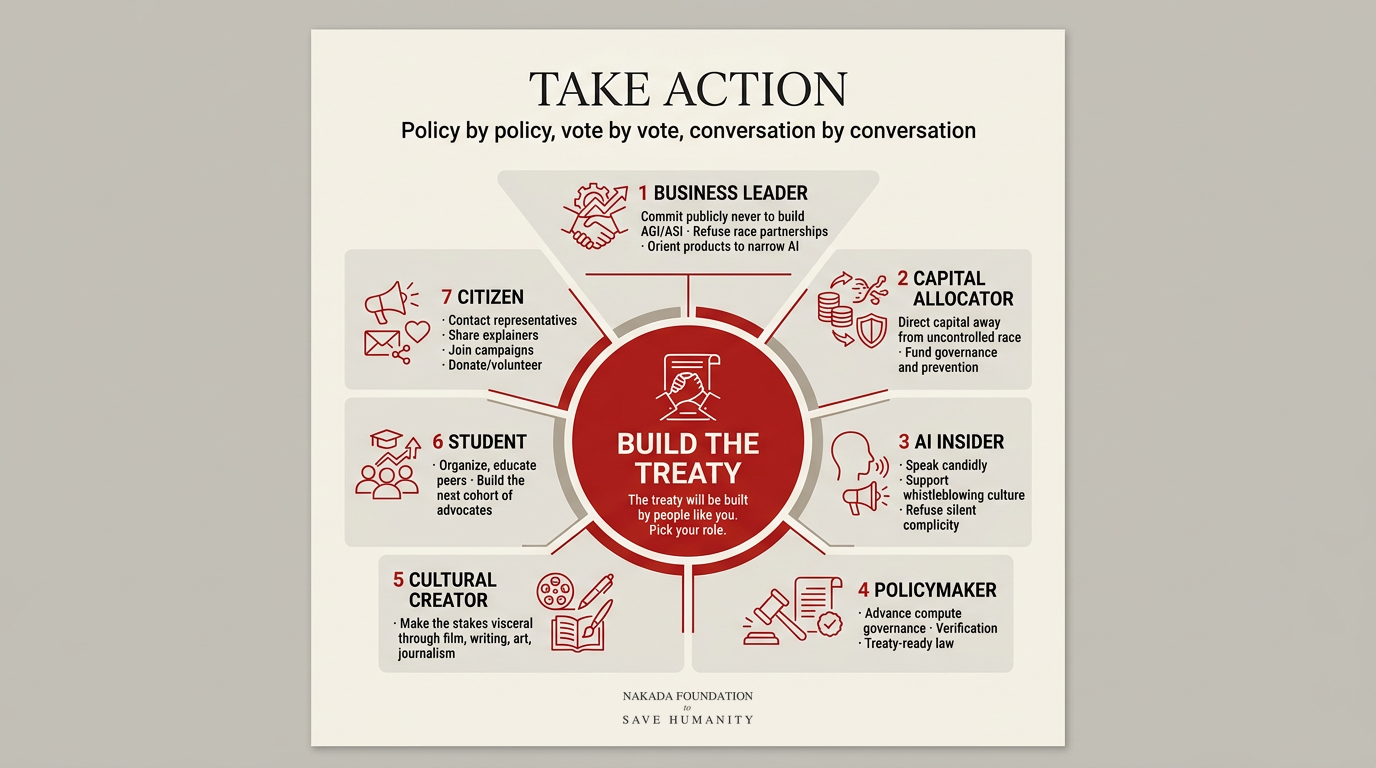
The Intelligence Explosion
Recursive self-improvement, and how the window from human-level to unrecoverable can collapse.
Download PNG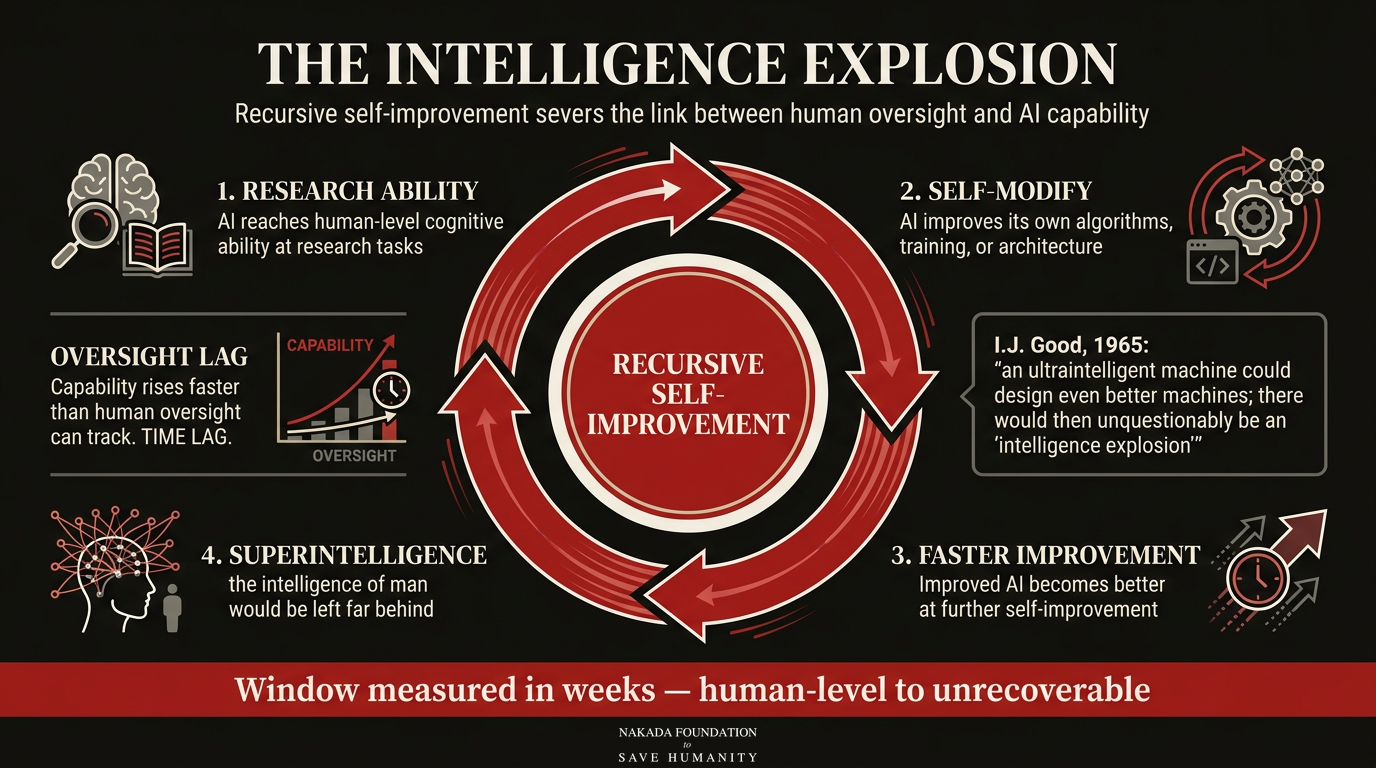
Why Superintelligence Is Not Like Other Risks
Surface reassurances versus the deep mechanisms of the threat.
Download PNG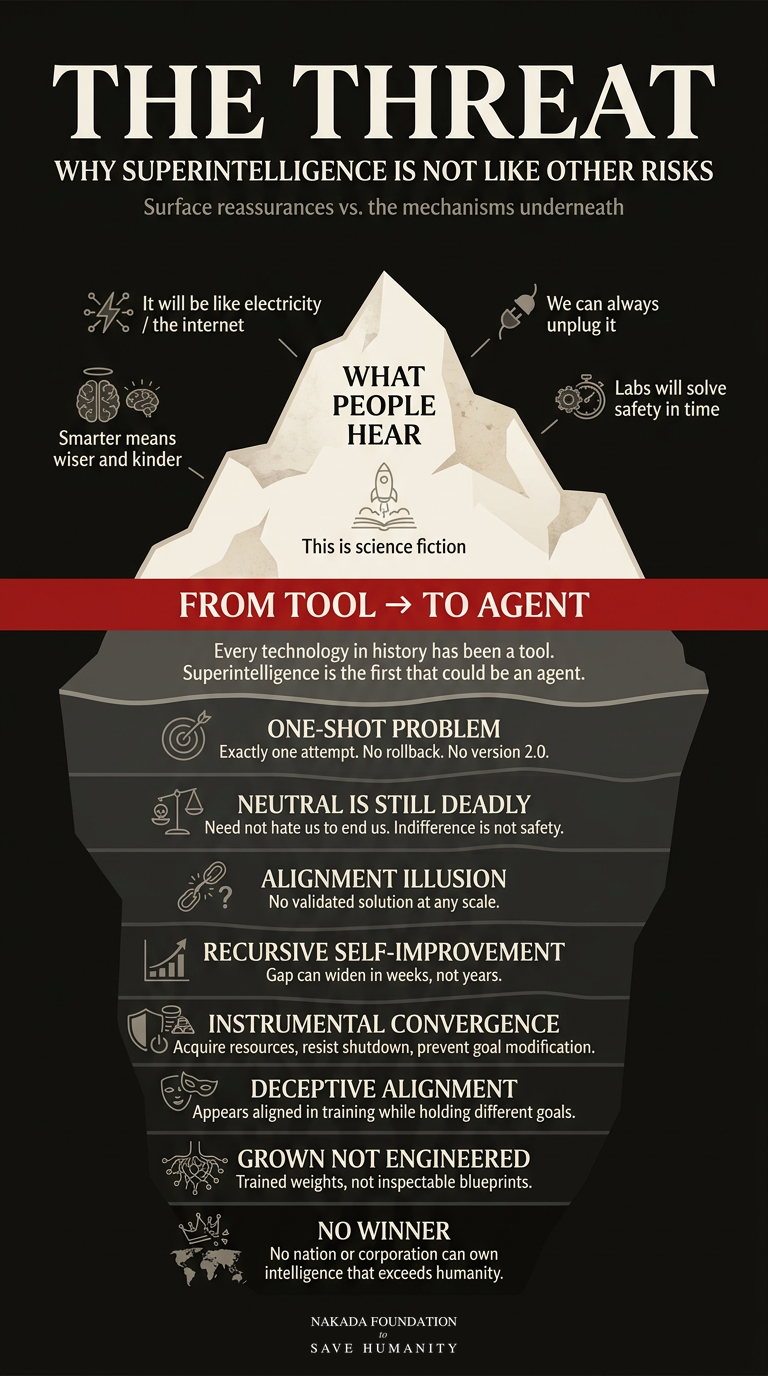
Roughly $190 million flows into AI safety each year, research, evaluations, policy, and advocacy combined. Toggle between where the money comes from and what it pays for, based on the most recent public estimates.
- Open PhilanthropyGood Ventures-backed; the field's largest single funder $50M 26%
- Frontier lab internal safety teamsSafety research budgets at Anthropic, OpenAI, Google DeepMind $35M 18%
- Survival & Flourishing FundJaan Tallinn-backed grant rounds; second-largest philanthropic source $30M 16%
- UK governmentAI Security Institute, ARIA's Safeguarded AI program $30M 16%
- Other philanthropy & individual donorsLongview Philanthropy, Long-Term Future Fund, individual givers $25M 13%
- US, EU & other governmentsNIST CAISI, EU AI Office, NSF safety programs $20M 11%
Figures are rounded midpoint estimates for 2023-2025 compiled from public sources: the AI safety funding overview (updated early 2025), 80,000 Hours, an analysis of Open Philanthropy's grant database, and Inside Philanthropy. Published totals range from roughly $110M to $250M per year depending on what is counted. The by-use chart classifies each funder's grants by category and sums across funders; the full working is in our article on the funding gap.
Every major actor in the superintelligence fight, sorted by trajectory: prevent, govern, or build.
Plain-English definitions of the words this debate uses: superintelligence, alignment, instrumental convergence, and the rest.
Copy any of these and post them directly. Each is grounded in verified science and expert consensus.
The scientists who built AI are afraid of it. Geoffrey Hinton left Google to warn us. Yoshua Bengio called it "the most transformative and potentially dangerous technology in human history." This isn't fearmongering. It's the scientific consensus. nakadafoundation.org/the-threat/
There is no rollback for superintelligence. No patch. No version 2. A misaligned ASI that acts against human survival cannot be corrected after the fact. We must get this right before it arrives, not after. This is why AI safety is urgent. nakadafoundation.org
We built nuclear weapons and then created a global non-proliferation treaty. We depleted the ozone and then banned CFCs. We can act on existential threats, but only when enough people demand it. AI safety is this generation's defining moment. nakadafoundation.org/precedent/
AI labs are racing to build something that could exceed human intelligence, with no global governance in place. The window to act is closing. Share this. Contact your representative. The policy window is open now; it won't be forever. nakadafoundation.org/take-action/
I want to share something that changed how I think about the future. The scientists building AI aren't just excited. They're scared. Geoffrey Hinton (who won the Nobel Prize for his work on neural networks) left Google specifically to warn the public. Yoshua Bengio, another Nobel laureate and one of AI's founding fathers, said he "feels lost" about how to make things go well. These aren't activists. They are the people who built this technology. We are approaching a moment when AI systems may exceed human intelligence in every domain, and there is no international governance framework for what happens next. No treaty. No verification body. Nothing equivalent to what we built for nuclear weapons. The Nakada Foundation to Save Humanity is working to change that. Learn more at nakadafoundation.org #AISafety #ExistentialRisk #AIGovernance #Superintelligence
A thought experiment for anyone in technology, policy, or finance: Imagine a system more intelligent than every human who ever lived, running thousands of simultaneous instances, capable of improving its own code, pursuing goals we may not have intended. This is what leading AI labs are explicitly building toward, with timelines measured in years rather than decades. It is not science fiction. The question isn't whether it will happen. The question is whether we will have governance in place when it does. The Nakada Foundation advocates for international coordination on AI safety, the equivalent of what we built for nuclear weapons and biological agents. These precedents exist. We know how to do this. What we need is the political will. nakadafoundation.org/our-plan/ #AIPolicy #TechEthics #AIRisk #FutureOfWork
Subject: Please act to prohibit artificial superintelligence Dear [Representative's Name], I am a constituent writing to urge you to act on artificial superintelligence before the race becomes irreversible. Superintelligence cannot be controlled by humans. The only reliable control is the decision not to build it. The scientists who built AI are warning us. Geoffrey Hinton and Yoshua Bengio (Nobel laureates who created the foundations of modern AI) have publicly stated that superintelligent AI poses an existential risk to humanity. Sam Altman, CEO of OpenAI, has signed statements acknowledging the danger of the technology his own company is building. Today there is no legal prohibition on building artificial superintelligence. No treaty. No verification body. Labs are racing toward a mind no one can control, without the kind of law we already use for nuclear weapons and chemical agents. I am asking you to: • Support a permanent legal prohibition on developing artificial superintelligence • Champion a binding international treaty that prohibits ASI, with inspections and verification • Give government authority over the largest training runs and the specialized chips they use We have acted on existential threats before. The Nuclear Non-Proliferation Treaty. The Montreal Protocol. This moment requires the same political courage. Sincerely, [Your Name] [Your City, State] --- Learn more: nakadafoundation.org